
Is Ragi For Babies Really a Superfood? Let’s Look at the Facts
MOORAV FOODTECH PRIVATE LIMITED AdminYour baby has crossed six months, and suddenly everyone has a food recommendation! Every second parenting group, every second aunty at a family gathering, and every second “top 10 baby foods” list has an opinion on ragi for babies.
And then comes the big question: Is ragi really a superfood for babies, or is it simply another traditional food that has been given a modern health label? Well, the truth is somewhere in between!!
It is called a superfood, a miracle grain, and the secret behind strong bones, but how much of that is actually true?
Fact: ICAR describes finger millet as a nutrient-rich crop and reports calcium levels of around 344 mg per 100 g in finger millet.
Let's cut through the noise and look at what the science, the nutrition data, and the guidelines actually say.
What Exactly Is Ragi?
Ragi is the Indian name commonly used for finger millet and is scientifically known as Eleusine coracana. It is a small reddish-brown grain that has quietly fed generations of Indian families long before “superfood” was even a word anyone used.
Most importantly, it is naturally gluten-free, easy to grow, and has been part of Indian childcare traditions for years.
Is Ragi Good for Babies? Yes. Ragi baby food can be a nutritious complementary food from around 6 months, when they are developmentally ready for solid foods. Today, it is increasingly popular in infant feeding because of its mineral and nutrient profile.
The Nutrition Data: Why Ragi Gets Called a Superfood
According to the ICMR's Indian Food Composition Tables, 2017, which is published by the National Institute of Nutrition, Hyderabad, ragi has one of the most impressive nutrient profiles among Indian cereals.
ICAR reports that finger millet contains approximately:
|
Nutrient |
Amount per 100 g |
Why It Matters for Babies |
|
Calcium |
344 mg |
Highest of any Indian cereal |
|
Iron |
3.9 mg |
Supports blood health and cognitive development |
|
Protein |
7.3 g |
Contributes to tissue growth and repair |
|
Dietary Fibre |
11.2 g |
Supports digestion |
|
Fat |
1.5 g |
Low-fat, easy on an infant's developing digestive system |
|
Glycaemic Index |
~54 |
Releases energy gradually and avoids sharp sugar spikes |
Let us take a moment to appreciate this calcium figure here. Despite the common belief among parents that milk is the optimal source of calcium, the benefits of ragi for infants surpass those of a single glass of milk, gram for gram.
That explains why ragi has traditionally been valued as a food for growing children.
When Should You Actually Introduce Ragi?
The World Health Organization's 2023 complementary feeding guidelines clearly state that infants should be exclusively breastfed for the first 6 months, and complementary foods like ragi should be introduced from 6 months onward, not before.
Moreover, WHO recommends offering complementary foods 2–3 times a day, gradually increasing variety, texture, and quantity as the child grows.
This isn't arbitrary. Iron deficiency is one of the most common nutritional gaps many parents have seen in early childhood worldwide. Introducing iron-supportive foods too late can raise anaemia risk. And introducing solids too early can interfere with exclusive breastfeeding and isn't recommended by WHO.
This is exactly why six months is the sweet spot where a baby's gut is developmentally ready, and their iron needs from breast milk alone start to fall short.
So, what is the best time to give ragi for babies? Right around 6 months, parents can start with a thin, single-grain porridge and gradually thicken it as their baby adjusts to solids over the following weeks.
How to Make Ragi for Babies

Now that you know when your baby is ready to rely on ragi or the best time to give ragi for babies, the next thing that may come to your mind is how to make ragi for babies in a simple way.
Ragi is one of the simplest first foods you can prepare. Here is how to prepare it:
- To make a ragi recipe for infant, start with ragi flour (either homemade or a trusted store-bought option) mixed with water or breast milk to form a thin or smooth porridge.
- Stir the mixture consistently over low heat until the mixture thickens a little and gets rid of its raw smell. Here, you need to wait patiently, as this usually takes just a few minutes.
- Strain if you are preparing for very young babies just starting solids. Make sure it has a completely smooth, lump-free texture.
- Gradually thicken the consistency over the following weeks. This will help the baby get more comfortable with solids.
- Introduce one new food at a time. Wait a few days between new ingredients, so you can watch for any reaction.This basic method is the foundation for most ragi recipes for babies.
|
One Thing to Skip ❌: Do not add sugar, salt, or honey simply to make the porridge taste sweeter or savory. WHO advises against adding salt or sugar to foods for babies and young children. |
5 Easy Ragi Recipes for Infants

Before we get into it, you need to know that you don't need to feel pressured to create elaborate recipes, as we have mentioned some of the easiest ragi recipe for infants here:
- Plain Ragi Porridge: Cook ragi flour thoroughly with water until smooth and soft.
- Ragi + Banana Porridge: Once banana has already been introduced separately, you can combine mashed ripe banana with cooked ragi.
- Ragi + Vegetable Porridge: Cook ragi with a smooth vegetable puree such as pumpkin, carrot, or sweet potato. Let us tell you this is the most preferred ragi recipe for infants by Indian parents.
- Ragi + Dal Porridge: As your baby's complementary diet expands, cooked dal can be combined with ragi to create a more nutritionally diverse meal. This is mostly useful because ragi itself isn't a complete source of all nutrients a growing infant needs.
-
Ragi + Fruit Meal: For older babies who are already comfortable with different foods, cooked ragi can be paired with mashed fruit such as banana, pear, or mango.
Related reads : Is Ragi Roti Better Than Rice
Ragi vs Infant Formula: A Quick Comparison
A lot of parents ask how a traditional grain like ragi measures up against commercial infant formula easily available everywhere. Let us be clear here that ragi is a complementary food, not a milk replacement, and it should never replace breastmilk or formula in a baby's first year. Period!!
But as a comparison of what each brings to the table, here we go:
|
Factor |
Ragi Porridge |
Infant Formula |
|
Purpose |
Complementary solid food |
Primary milk source (from birth, if not breastfeeding) |
|
Calcium |
344 mg/100 g |
Fortified to meet infant calcium needs |
|
Iron |
3.9 mg/100 g |
Fortified with added iron for bioavailability |
|
Gluten |
Naturally gluten-free |
Usually gluten-free |
|
Preparation |
Home-cooked with minimal processing |
Manufactured, standardised, and requires clean water for mixing |
|
Cost |
Generally low-cost |
Recurring expense. Plus, often higher ongoing cost |
|
Role in diet |
Introduces texture, taste, and whole-food nutrition |
Meets complete nutritional needs in early infancy |
If we conclude this table, formula and ragi baby food aren't competing with each other. They are just serving different purposes at different stages.
What About Ragi vs Breast Milk?
This comparison between ragi for babies and breast milk isn't really an “either-or” situation. As we already said, the WHO says that breastfeeding should be done for the first six months and then continued with other foods for at least two years.
Even after six months, breast milk is still a good source of nutrition for babies, even as they learn to eat more different foods.
Ragi Benefits for Babies
Now that you almost know what you need to know as a parent about ragi for babies, here are some noteworthy ragi benefits for babies:
- Bone and Teeth Development: The calcium content of ragi is among the best of any grain-based first food for babies.
- Supports Iron Levels: Ragi is a meaningful contributor to a baby's overall iron intake, especially when it is paired with vitamin C-rich foods (like a bit of mashed fruit) to improve absorption.
- Naturally Gluten-Free: It could be a safer starting grain for babies being introduced to solids for the first time.
- Gentle on Digestion: Its fibre content supports regular bowel movements without being harsh on a developing gut.
- Low Allergenic Potential: Ragi is not among the common major allergens. So, it could be a relatively low-risk first food.
- Steady Energy Release: Its moderate glycaemic index causes no sharp energy spikes or crashes.
That’s it for the benefits. On the contrary, even a nutrient-dense grain has limits. Look below 👇
|
A Word of Caution: What Ragi Isn't ⚠️
|
10on10 Foods and Their Ragi Offering
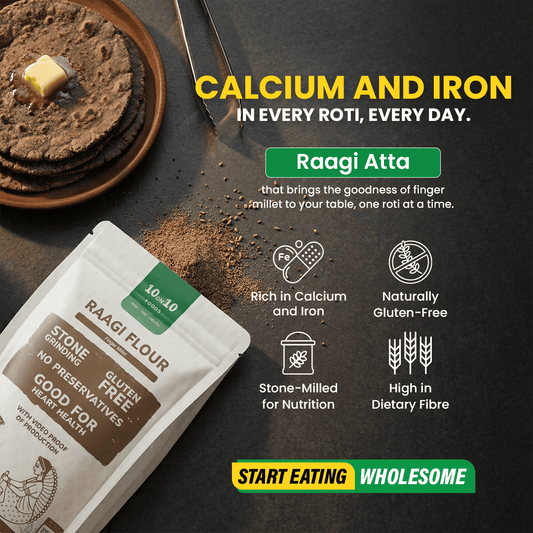
If you'd rather not spend your evenings grinding grain at home, get your hands on 10on10 Foods ragi flour for babies. For ragi or other grains, our approach centres on minimally processed, stone-ground ragi flour, rather than stripping it out through high-heat industrial processing.
The difference is more important than it seems for parents who are switching to ragi for babies. On the contrary, a lot of commercial baby cereals are heavily processed and sometimes bulked up with fillers or added sugars.
So, 10on10 Foods offers clean ragi, single-ingredient, stone-ground flour that gives you more control over exactly what goes into your baby's first bowl of meal. However, if you’re looking to buy ragi flour online, check out this one.
The Bottom Line
At last, we have to say that ragi deserves its reputation, but not the hype.
It is a traditional grain that is high in nutrients, especially calcium, and it can be a great addition to a baby's complementary food journey starting at six months of age. But the healthiest approach isn't to search for one “superfood”. It's to build a colourful, varied and age-appropriate diet.
So, if your little one is ready for solids, a warm bowl of well-cooked ragi porridge made with 10on10 Foods ragi flour can absolutely have a place on the menu.
It’s that simple!!!
FAQs
Q1: Is ragi really a superfood for babies, or is that just marketing?
A: Ragi is genuinely a superfood as it offers 344 mg of calcium and 3.9 mg of iron per 100 g.
Q2: What is the best time to give ragi for babies?
A: The appropriate starting point is 6 months of age, alongside continued breastfeeding, not before that.
Q3: Can ragi cause any side effects in babies?
A: Since ragi is naturally gluten-free, it is low-allergenic. But every baby should be introduced to it individually. Whereas, parents must watch for any reaction over a few days.