Gut Health
The average urban Indian eats roughly half the fibre they should, and it is not because we stopped eating grain.
It is because of what happens to the grain. A high speed roller mill separates the bran and germ, grinds the starchy endosperm into something soft and pale, and sells you back a fraction of what went in. The fibre your gut wanted was in the part that got removed.
What your gut is actually asking for
Two different things, and most people only get one.
- Insoluble fibre, which is the bran. It is bulk. It keeps things moving and keeps you regular.
- Fermentable fibre, meaning beta glucan, resistant starch and arabinoxylans. This is the part your gut bacteria actually eat, and what they produce in return, short chain fatty acids such as butyrate, is what feeds your gut lining.
Freshly stone ground whole grain gives you both, because nothing was taken out. That is the entire mechanism. There is no probiotic shortcut that beats simply eating the whole grain.
Recommended for you
Six flours from our range, chosen for this concern and ranked by how much difference they make.

The highest fibre wheat we mill, and it behaves like normal atta in the kitchen.

Unusually rich in beta glucan, the fermentable fibre your gut bacteria like best. Blend 20% into your atta.

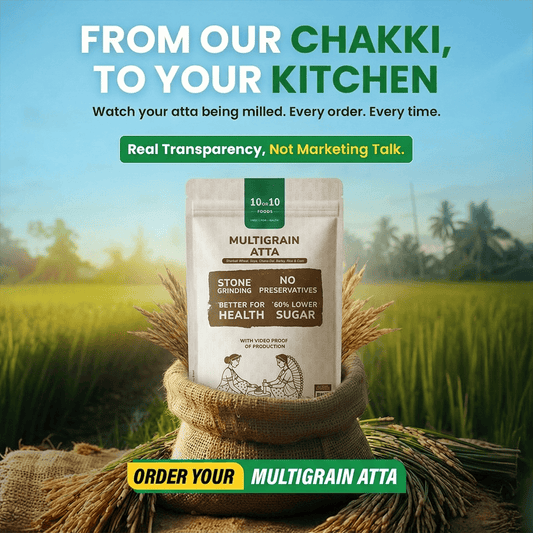
Eight grains means eight fibre structures. Fibre diversity is the best predictor of a diverse microbiome.

Extremely high fibre by weight. Use small amounts because it drinks liquid, but a little goes far.

Coarse, hearty and high in insoluble fibre. The classic winter roti, and there is a reason it fills you up.

The baseline done properly. Nothing sifted out, ground after you order. Ask for coarse.
How to actually do this, this week
- Ramp up slowly. Going from 12g to 30g of fibre in one day will make you bloated and convince you fibre is the problem. Add one swap a week.
- Drink more water. Fibre without water is worse than no fibre. This is the step everyone skips.
- Let rotis cool. Cooked then cooled starch forms resistant starch, which behaves like fibre. Yesterday's roti is genuinely better for your gut than a fresh one.
- Mix your grains across the week rather than picking one and eating only that.
Where this comes from
- Aune D, et al. Whole grain consumption and risk of cardiovascular disease, cancer, and all cause and cause specific mortality. BMJ, 2016;353:i2716. Read the paper
- EFSA. Barley beta glucans and lowering of blood cholesterol. EFSA Journal, 2011. Read the opinion
- Devi PB, et al. Finger millet: a review of its nutritional properties, processing, and plausible health benefits. Read the review
Nutrition information, not medical advice. If you have IBS, coeliac disease, IBD or a diagnosed gut condition, high fibre and high gluten grains may not suit you. Check with your doctor or dietitian first.
-
100% Whole Wheat Chakki Atta, Stone-Ground Fresh
Regular price From Rs. 85.00Regular priceUnit price per -
8-Grain Multigrain Atta, Stone-Ground, Milled Fresh
Regular price From Rs. 119.00Regular priceUnit price per -
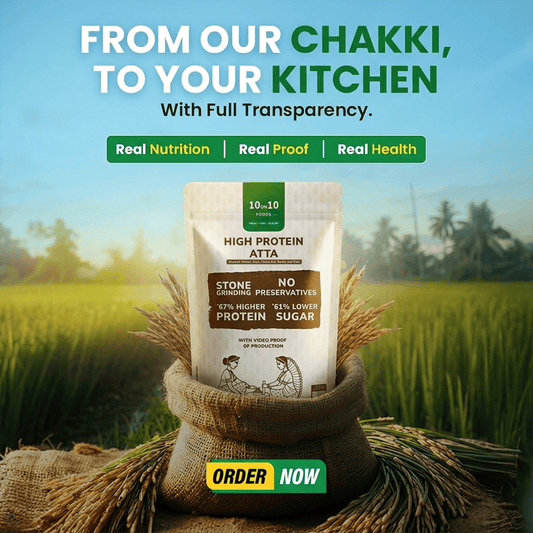
High Protein Atta, 25g Protein, Stone-Ground Fresh
Regular price From Rs. 149.00Regular priceUnit price per