
Best Millet for Your Body Type: Jowar, Ragi or Bajra?
MOORAV FOODTECH PRIVATE LIMITED AdminShare
There was a time when our parents or grandparents didn't have to choose between gluten-free, whole grains, or superfoods. They simply ate what their land had given them.
Unlike today, millets like jowar, ragi, or bajra weren’t go-to wellness choices; instead, they were survival, tradition, and nourishment all rolled into one. However, these grains have fed civilisations for over 5,000 years. Yet, for many of you, they remain mysterious grains, especially if you grew up on wheat rotis and rice.
On the contrary, they are back on Indian plates because they fit modern needs. The fact that all three of them are gluten-free, nutrient-dense, and fundamentally different in how they interact with your body, your digestion, and your energy.
This guide compares ragi vs jowar vs bajra and suggests the right millet that matches your body type, your climate, your metabolism, and your health goals.
For a deeper jowar deep-dive, see our pillar guide
Understanding Three Superfoods: Ragi vs Jowar vs Bajra
Having said that, each millet is different and works differently for your body. So, if you are wondering which millet flour is best for your body type, let’s first understand the foundational jowar ragi bajra differences:
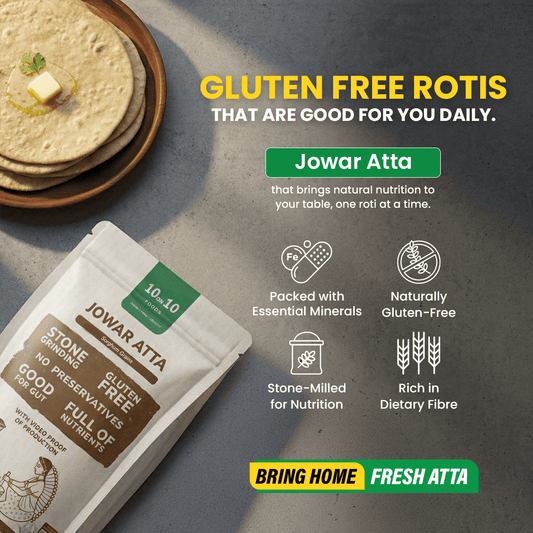
Jowar or Sorghum (Best For Summers or Warmer Climates)
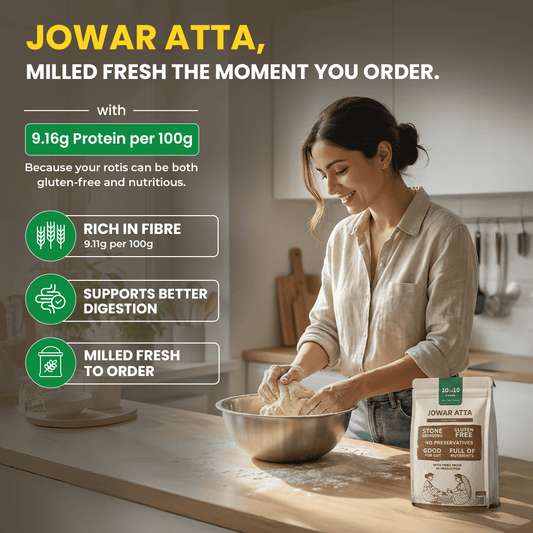
Jowar, scientifically known as sorghum, is one of the grains that support digestion. Plus, the fibre in jowar acts as a natural prebiotic, which feeds the beneficial gut bacteria. On top of that, if you regularly consume jowar in the form of roti or something else, it helps maintain steady sugar levels. Jowar flour benefits include being the best millet flour for weight loss and for people with prediabetic conditions.
Key Characteristics:
- It has a light and balanced grain structure.
- High in fibre.
- Includes antioxidants and B vitamins.
- Naturally gluten free millet flour.
- It has a low glycemic index for stable energy.
- Rich in magnesium and potassium.
Ragi or Finger Millet (Best For Summers)
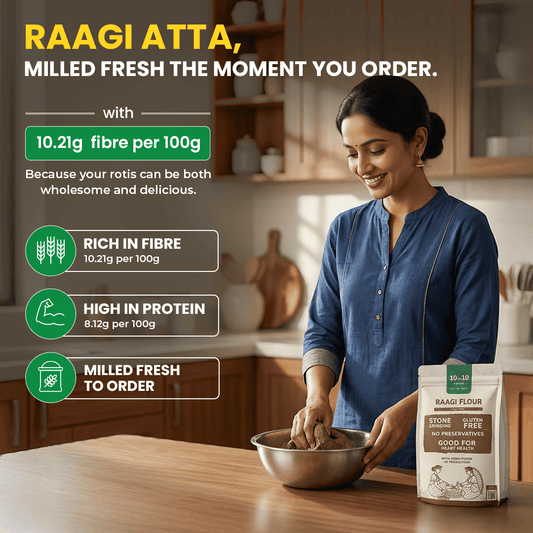
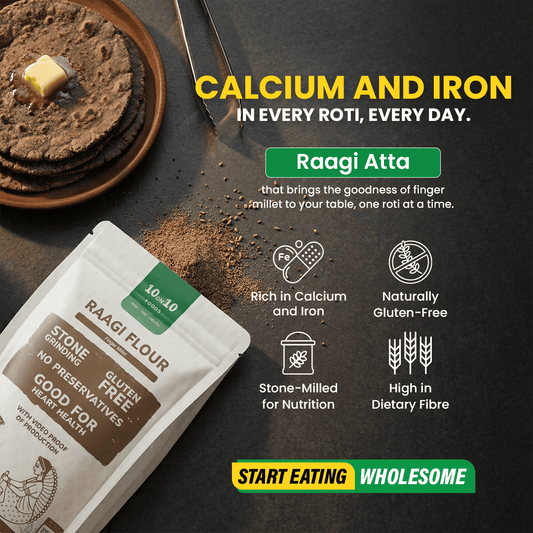
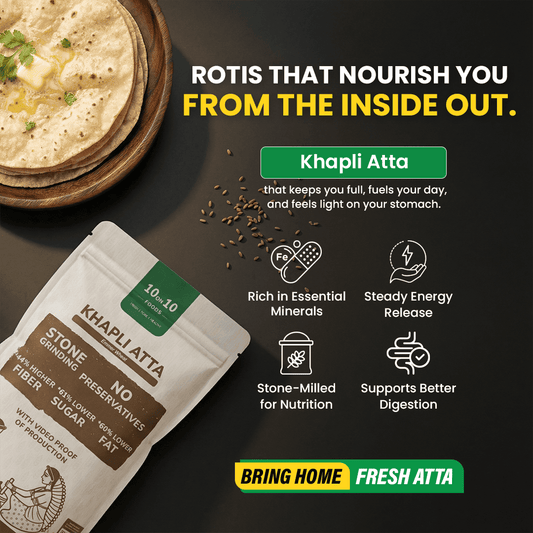
Ragi grain is known as the nutrition powerhouse. If someone has poor bone strength and low calcium, ragi is the millet they consider consuming. Besides calcium, ragi is also high in iron and fibre. Overall, this millet is an absolute choice for growing children, post-menopausal women, and anyone with a history of bone weakness or osteoporosis.
Ragi flour benefits:
- Extremely high in calcium.
- Rich in iron, which boosts energy and improves blood health.
- Smallest grain size for easy digestion.
- Low glycemic index.
- Contains tryptophan, an α-amino acid (to support mental calm).
- Perfect for bone and skeletal muscle.
Bajra Aka Pearl Millet (Consume in Winters or Colder Months)
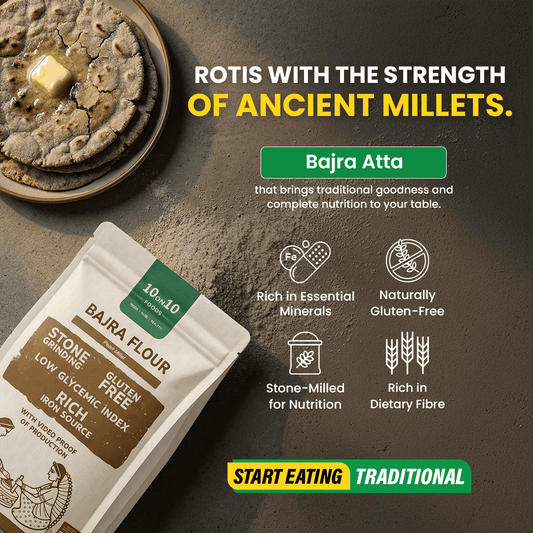
Bajra is a bold, earthy, and deeply satisfying millet. Plus, it is a highly nutritious, gluten-free, and drought-resistant grain which is mostly cultivated in arid regions of Africa and India.
If your body demands energy, muscle support, and the stamina to power through demanding days, start eating roti made of bajra atta (a simple change) and feel the difference.
Key Characteristics:
- Thicker grain structure.
- High in protein and iron.
- Rich in magnesium, which supports muscle and nerve function.
- Creates a warming effect in the body (as per the Ayurvedic perspective.
- High soluble fibre.
- Provides sustainable energy for physically demanding tasks.
At the end, if you are allergic or if bajra makes you feel heavy, use ragi or jowar atta. And when you are not allergic but still not feeling good about it, adjust the quantity or how frequently you consume it.
Wondering about jowar's body effects? Is jowar hot or cold?
How To Choose Millet Flour For Your Body Type?
Before choosing one, you must know your body first. For that, you have to take the digestive strength, metabolic rate, activity level, and seasonal requirements of your body into account.
Once you have that knowledge, you are ready to start.
Choose Jowar If You:
If you have sensitive digestion, you often feel bloated or sluggish. Jowar is light on the stomach and is naturally gluten-free. On top of that, its balanced nutrition profile and gentle digestion make it a perfect choice for people having a sedentary to moderate activity lifestyle, who sit for long hours or feel low energy after meals.
Moreover, if you are up for various health goals like weight management, stable blood sugar, and regular digestion, jowar is the grain that works with a condition-prone body, not against it. Make sure to consume soft jowar rotis made of jowar flour during summer and warmer months, as its lightness balances heat.
Note 📝: Jowar can cause gut irritation, so start with 25–30% jowar atta mixed with wheat flour and then gradually increase the ratio over 2–3 weeks.
Choose Ragi If You:
Now, if your major concern is related to calcium and bone health, then get ragi flour. Ragi's calcium and iron content addresses deficiencies that don’t respond well to supplements alone. In addition, its calming properties support mental focus.
For instance, a small kid who is struggling with anaemia despite iron supplements. The paediatrician recommended adding ragi to the diet in the form of ragi rotis, ragi dosa, or ragi porridge. The hemoglobin levels had returned to normal six months later, according to a paediatrician.
However, the ragi flour benefits weren't just limited to nutritional levels; they are transformative for a child whose energy and focus had been compromised by low iron. Unlike jowar, you can have it year-round.
Note 📝: Since ragi is high in fibre and minerals, jumping straight to it may overwhelm the digestion. You can start with 1 small serving per day and then increase over 10–14 days.
Choose Bajra If You:
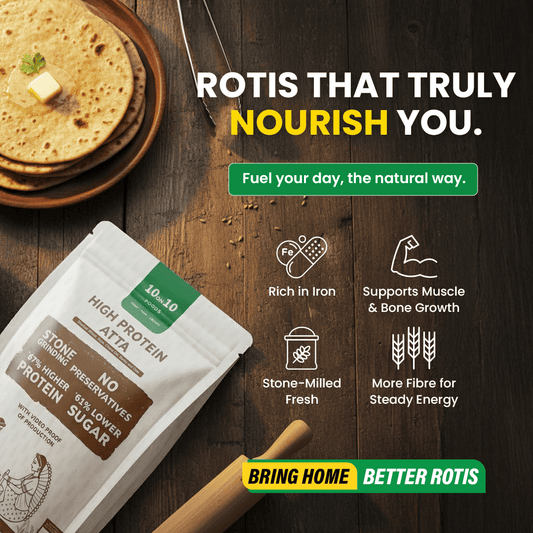
Besides those specialised flours like high-protein or multigrain atta, bajra flour is also the best flour for protein intake, especially during winter and colder months. Bajra's density and protein content create satiety that lasts longer than jowar. It is great for a number of health goals like muscle building, cardiovascular support, long-lasting energy, and weight management through satiety.
However, if you are an athlete, labourer, or someone engaged in strength training, then look no further than bajra flour.
Note 📝: Do not switch to bajra overnight. First, try out with 20–30% bajra atta mixed with wheat flour and then increase the quantity over 2–3 weeks. It is suggested because your digestive system needs time to adjust to its density.
To conclude, you can consume jowar flour if you have a condition-prone body, switch to ragi for the growth of children, and bajra to amplify the protein intake.
Why Choose 10on10 Foods For Millet Flours?
To select the best millet atta for daily use, quality matters just as much as choice, and it's been decades since 10on10 Foods remained the top choice. It is simply because 10on10 Foods ensures:
- Premium-quality grains.
- Minimal and stone-ground processing for maximum nutrition.
- Fresh and hygienic packaging.
- Easy availability, including jowar atta online.
We differentiate ourselves in the following aspects:
|
Aspect |
Generic Brand |
10on10 Foods |
|
Milling |
Weeks or months old |
Fresh (within 24-48 hrs) |
|
Transparency |
None |
QR code video proof |
|
Method |
Steel mills (heat grain) |
Stone mills (preserves nutrition) |
|
Additives |
Often included |
Single ingredient only |
|
Results |
Uncertain timeline |
Specific week-by-week outcomes |
Overall, whether you are looking for fresh, specialised flours or millet flours, 10on10 Foods makes it easier for you to adopt a healthier lifestyle without compromise.
Conclusion
The real insight found from ragi vs jowar vs bajra comparison isn’t that one is objectively best. It is something that your ancestors understood, and we’ve forgotten, not the trendiest one on social media.
Your body knows what it needs, and you have to pay attention to how your body feels.
Ready for a fresh yet healthy start? Choose 10on10 Foods to get fresh-milled atta. Till then, eat mindfully, stay consistent with your health goals, and let your food take care of you.
FAQs
Q1: Can I completely replace wheat with millet flour?
A: Yes, you can. But, if you’ve never tried millet flour before, you are recommended to start by mixing 25% millet with 75% wheat atta for the first two weeks. This way, your digestive system will adapt to the increased fibre content. Then, you can gradually increase your reliance on it.
Q2: How should I store millet atta?
A: Fresh millet attas are recommended to be consumed within 2 weeks of milling. Otherwise, you can store millet flours like jowar atta in an airtight container in a cool, dry place. Moreover, refrigeration extends its freshness to 4 weeks.
Q3: Can people with diabetes eat millet flour freely?
A: The fact that millet flours typically have low glycemic indices, but having control over portions still makes sense. For example, a serving of millet atta per individual should be roughly the size of your palm.
Q4: Can I mix different millet flours together?
A: Yes! There is nothing wrong with it. In fact, blending 50% jowar, 25% ragi, and 25% bajra flour can provide you with balanced, nutritious flour. Overall, it will deliver the benefits of all three millets without feeding your stomach with one variety.