
Why Improving Atta Quality Can Transform Your Daily Nutrition?
MOORAV FOODTECH PRIVATE LIMITED AdminIn millions of Indian kitchens, the same routine is followed every morning: the dough is kneaded, the tawa is heated, and the first roti of the day quietly and confidently puffs up. Given that, it is unquestionably the most consumed food in India. In fact, wheat contributes roughly one-fifth of global daily calories and protein intake.
While practicing the same routine daily, have you ever paused to ask, “What exactly is that roti made of, or is it giving your body what it truly deserves?” In other words, maybe it’s not about the product; it is about the process that is supposed to support the nutritional composition of the atta.
Well, all these thoughts come to a final conclusion, i.e., improved atta quality can only transform your daily nutrition. Once you get it right, your most ordinary meal will become your most powerful health tool.
This comprehensive blog post uncovers how to get your atta back in its true form, nutrition-rich, and purpose-rich flours like high-protein, jowar, and khapli atta are leading this transformation.

Get to Know About The Grain That Feeds the World
When it comes to understanding why atta quality matters, you must first have a look at wheat’s enormous footprint in human nutrition.
Coming back to it, in India, wheat is the second most consumed staple after rice. This demonstrates a greater contribution than any other single crop on earth. Statistics revealed that the daily protein intake per capita from wheat is approximately 16 grams, which represents 19% of total daily protein consumption globally. Are you finding these numbers small?
Let us correct you here…
Imagine, when a single ingredient is responsible for this much of humanity’s nourishment, the quality of that ingredient becomes a public health matter, besides just being a pantry preference.
Yet despite its dominance, most Indian households consume wheat in its most nutritionally compromised form, i.e., heavily milled, highly processed, stripped of its bran or germ, and lacking important components that make whole wheat a powerhouse.
The result? Many people in India consume only around 38 grams of protein daily. This is even below the ICMR-recommended 0.8 to 1 gram per kilogram of body weight. However, a person may experience fatigue, slow metabolism, muscle loss, dull skin, and compromised immunity.
And it all comes down to the atta lying on your kitchen shelf!!!
Why Improving Atta Quality Can Transform Your Daily Nutrition?
Around 40% of staple cereal consumption in India includes wheat. So, here is why upgrading your atta is one of the highly impactful nutritional decisions one can make:
- Frequency: The atta is consumed daily, consistently, and in meaningful quantities. Knowing that, even a modest improvement in protein or fibre per 100 grams is enough to create a noteworthy positive effect on annual nutrition.
- Whole Grain Matters More Than We Realize: While most commercial attas marketed as “whole wheat” are way more refined than what their label suggests. Since white flour corresponds to the starchy endosperm of the wheat grain, it is rich in starch but is low in essential nutrients like fibre, minerals, vitamins, and phytochemicals.
However, switching an atta to something organic and stone-ground can heighten your daily nutrition intake.
- The Gut Pays the Price: We Indians often take things for granted, especially when it comes to food. And, deep inside your body takes a toll. Similarly, when you remove the bran and germ from wheat, there will be no availability of important nutrients that feed your gut microbiome and regulate digestion.
As a result, you experience fast glucose absorption, sudden spikes in blood sugar, and metabolic disease.
Due to all these reasons, high-protein grains, ancient wheat varieties (like jowar, raagi, or bajra atta), and nutrient-dense millets are not the buzzwords, but worthwhile efforts for your health.
How Does Poor Quality Atta Affects Your Health?
Since, in India, wheat is the second most consumed staple after rice it needs to be of top-notch quality. The lasts few years have seen growing concerns about adverse effects of wheat on health, especially in India. This leaves people scratching their head figuring out is packaged atta safe and a “healthy” alternative?
On that note, here is how poor atta quality affects your health:
- Poor quality atta causes nutritional deficiency as it lacks lacks nutrients like fibre, iron, and B-vitamins needed for overall health.
- Highly refined flour can cause bloating, constipation, and acidity.
- Low quality atta gets digested quickly which increases the risk of sudden glucose spikes and diabetes.
- It impacts the gut health and cause digestive imbalance.
- It may expose the body to unwanted additives.
Types of Flours That Are Truly Beneficial
Below is the list of nutrition-rich flours you can consider adding to your diet. Continue reading to know about each of them:
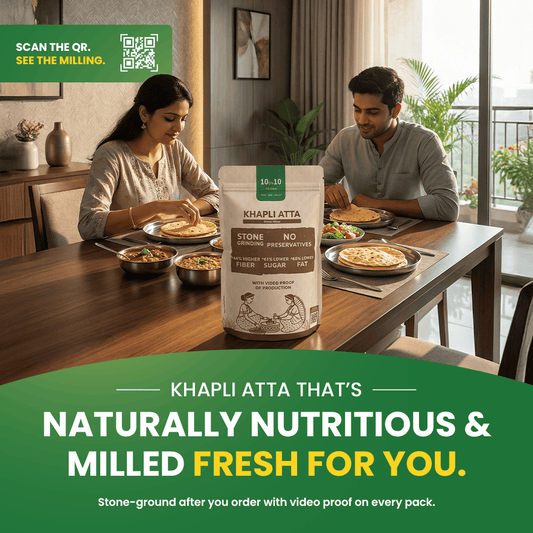
Khapli Atta
If there is one ingredient that best embodies the idea of nutrition, it is Khapli wheat. It is also known as Emmer wheat, or Triticum dicoccum, and is the oldest cultivated wheat in human history. These are not like those modern hybrid wheat varieties that are dominating the farms today. Indeed, Khapli has remained unchanged for many centuries.
Perhaps it is more important for Indian consumers, but unfortunately, Khapli wheat still accounts for less than 1% of total wheat cultivation due to lower yields and complex cultivation.
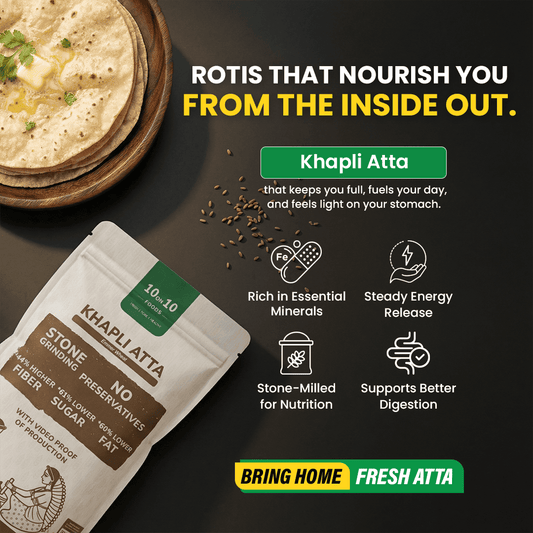
Nutritionally speaking, Khapli wheat offers a low glycemic index of 45–50 (which is much lower than regular wheat) and is rich in dietary fibres. Due to this fact, it is ideal for diabetics or individuals managing blood sugar levels, and supports digestion, gut health, and natural weight management.
Besides its macronutrient profile, Khapli wheat is rich in magnesium, iron, zinc, Vitamin B1, and antioxidant compounds.
Jowar (Jowar) Atta
Long before, when the wheat actually entered Indian kitchens, Jowar, aka Sorghum, was the only grain that sustained civilizations. Meaning, it has been around for more than 5,000 years. However, what began as a humble millet is now a superfood that is recognized globally.
Now, the popularity is not out of nostalgia, but there is a good reason behind it…
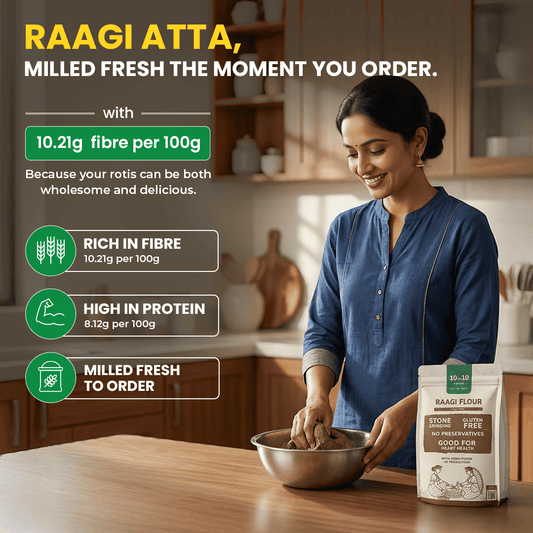
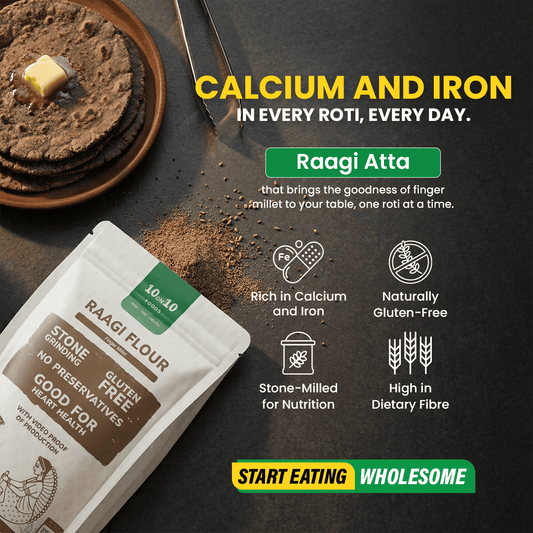
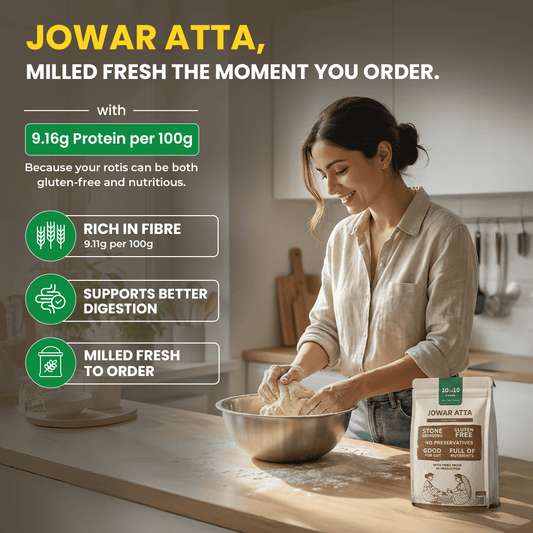
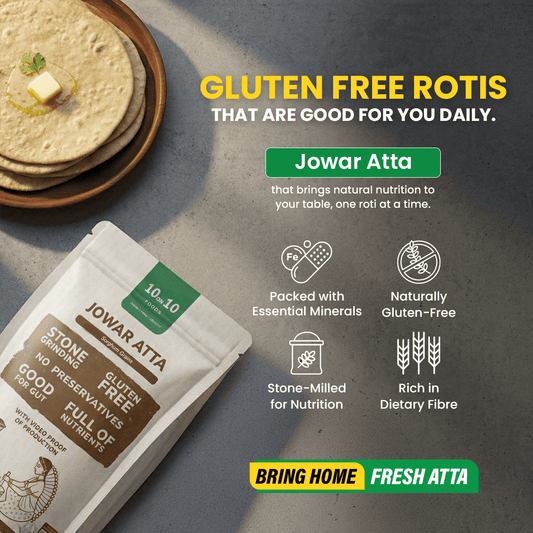
Its nutritional profile is genuinely impressive for modern dietary challenges. Jowar flour is completely gluten-free and is a great alternative for people with celiac disease and gluten sensitivity. When it comes to protein, Sorghum is superior to wheat in biological value and digestibility. In addition, jowar flour/atta is high in dietary fibre, has a low glycemic index, is rich in micronutrients, and has anti-inflammatory properties.
10on10 Food’s Jowar Atta retains 7g of dietary fibre and 11g of protein per 100g. Plus, the best part is, it is milled only after your order to preserve its light, slightly sweet flavour, and its mineral content.
High-Protein Atta
For the modern Indian society, balancing work, family, fitness aspirations, and the persistent challenge of consuming protein falls short. Protein bars and shakes have become a crutch. Fun fact, people have forgotten to know the difference between additive-laden and smart choices.
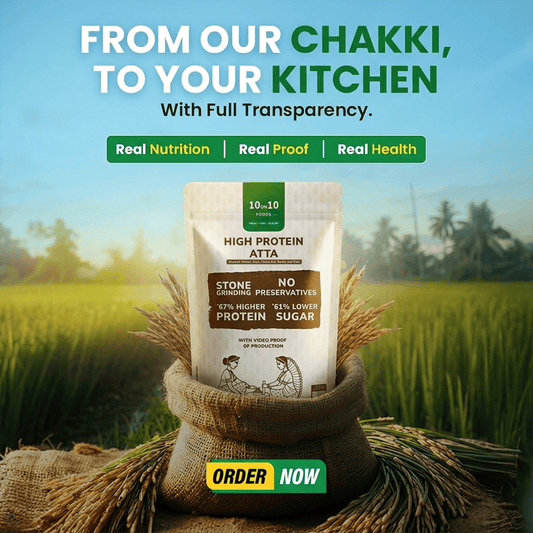
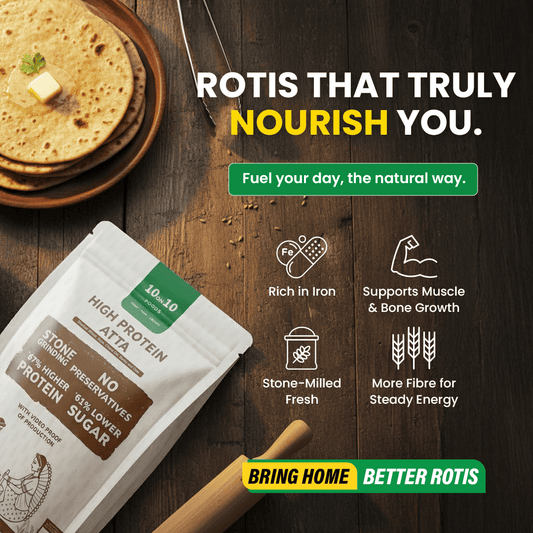
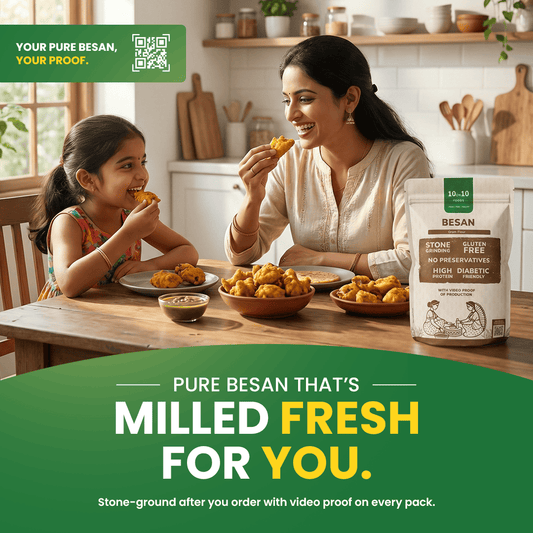
This is where high-protein atta enters the conversation. Instead of relying on supplements to fulfill your protein needs, high-protein atta allows people to include high-protein intake directly into everyday meals like rotis, parathas, and breads.
This upgrade not only improves the quality of atta you consume, but also offers a practical yet sustainable way to improve daily nutrition without relying on improper eating habits.
The Nutritional Face-Off: 10on10 Foods vs. Other Brands
We always recommend that people not believe the word of mouth. In this section, we let numbers do the talking, and here is a transparent, head-to-head nutritional comparison across key atta categories:
|
Essential Nutrients |
Other Brands |
10on10 Food’s Flour |
||||
|
Khapli |
Jowar |
High-Protein |
Khapli |
Jowar |
High-Protein |
|
|
Protein (per 100g) |
12g |
8g–10g |
14g-16g |
14.5g |
11g |
24.56g |
|
Dietary Fibre (per 100g) |
10g |
5g |
9g-10g |
14.5g |
7g |
12.68g |
|
Glycemic Index |
Low |
Medium |
Medium |
Low |
Low (50–55) |
Low |
As you can see in the table above, the difference isn’t marginal; it is transformational. While regular flours deliver the modest requirement for nutrients, 10on10 Food’s proven to be a meaningful upgrade across protein.
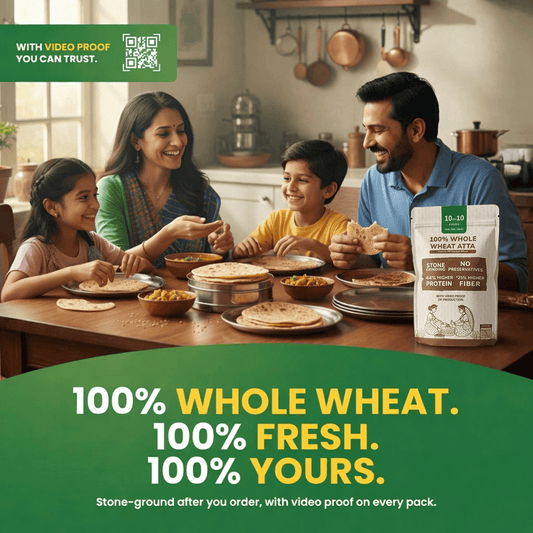
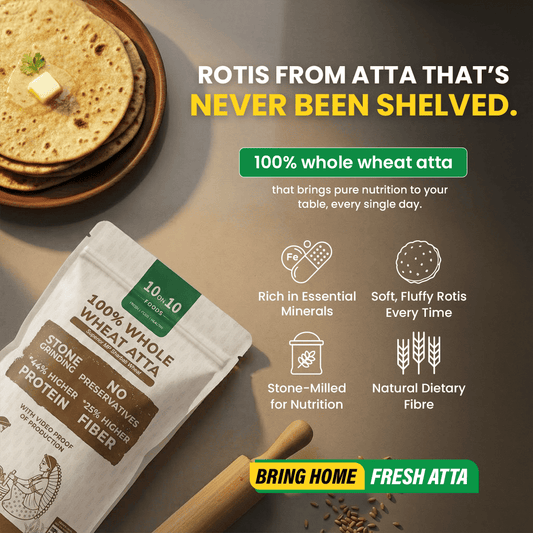
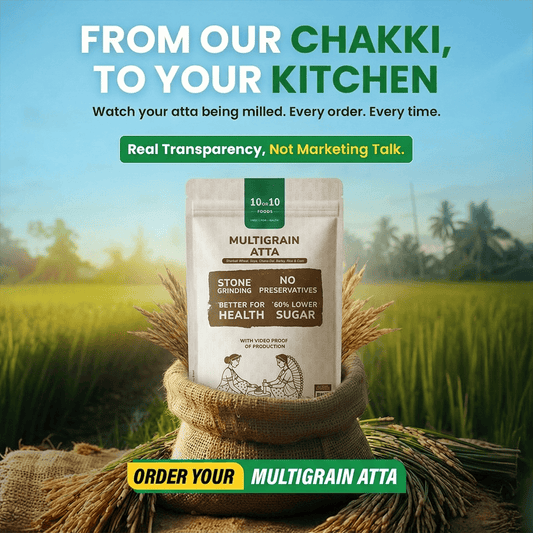
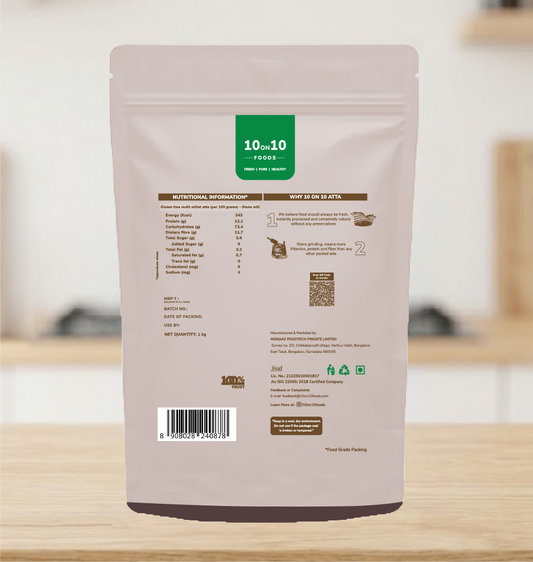
We distinguish ourselves from others due to our made-to-order model. Every pack is stone-ground fresh after your order is placed. Also, each pack even includes a QR code, which you can scan, and watch the actual milling of your specific order.
Final Words
“The path to better health begins with something as simple as the flour in your kitchen”.
At the end, we have to say that the greatest nutritional decisions are rarely dramatic. They are not about extreme diets, extreme restrictions, or expensive choices. They are about frequent yet wise choices made at the level of your daily habits.
And improving the atta quality is one of those choices. So, instead of settling for ordinary flour, make a switch to nutritionally enhanced options to turn every roti into a smarter, healthier meal.
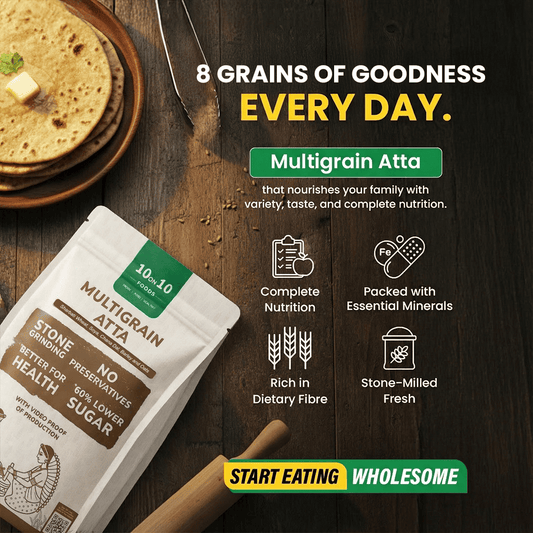
10on10 Food’s purpose-rich flour, it is Khapli, Jowar, or high-protein flour; each atta category delivers better protein, more fibre, and adequate nutrition in every bite.
No more upset stomach, no more gastric issues, and no more compromising on everyday nutrition, just wholesome goodness in every bite.
Upgrade your rotis. Upgrade your nutrition with 10on10 Foods!
FAQs
Q1: Why is wheat considered an important staple worldwide?
A: In India, wheat is the second most consumed staple. Also, it provides around 20% of global calories and protein intake. Consequently, this makes it an essential food crop globally.
Q2: How to improve your daily nutrition?
A: The easiest way for Indian consumers to improve their daily nutrition is by improving their atta quality. For that, you can mix the regular wheat flour with purpose-rich flours, as listed above.
Q3: Can Jowar atta be used as a complete replacement for wheat flour in everyday cooking?
A: Why not? Back then, people used to consume Jowar atta only because it was associated with various health benefits. Plus, it works beautifully for traditional Indian flatbreads like rotis, bhakris, and parathas.
Q4: How much protein can I realistically expect from 10on10 Foods' High Protein Atta per day?
A: 10on10 Food’s high protein atta provides 24.56g of protein per 100g. And, 35g of dough of high-protein flour gives you approximately 8.75g of protein per roti.
Q5: Why is the glycemic index of atta important, and which 10on10 atta is best for diabetics?
A: It is important to know the glycemic index of atta because it measures how rapidly a food raises your blood sugar after consumption. Well, GI is generally better when it is low (55 or less). Among 10on10 Foods' range, Khapli atta and Jowar atta carry the lowest GI, which is best for diabetic individuals.
Q6: Is Khapli atta better than regular wheat flour?
A: Absolutely yes, Khapli atta has a low GI, high fibre, and better mineral content. So, it is ultimately a better choice than regular wheat flour.