
High Protein Atta: What the Research Supports, and What It Doesn't
10on10 Foods Research DeskShare
Wheat is short of one amino acid. Jowar was tested at 30%, not 100%. And the khapli study the whole category leans on measured something other than blood sugar.
There is a number on the front of every protein atta bag in India right now, and it is doing a great deal of work. Ours says 25g. Another says 17g. A third says 40g. The shopper's reasonable assumption is that a bigger number means more protein doing its job in your body.
It is not that simple, and the reason has been in the nutrition literature for years. Protein is not one substance. It is a string of amino acids, and your body can only build with a protein up to the point where its scarcest essential amino acid runs out. Wheat has a well-documented shortage of one of them.
Here is what three papers actually say, what that means for the flour in your kitchen, and a calculator built only on figures we can show you the source of. We have included the finding that works against one of our own products, because you would find it eventually.
Wheat is short of lysine. That is why there is soya in our atta.
Wheat protein scores 54 out of 100 on the FAO's preferred measure. The amino acid holding it back is lysine.
Protein quality is assessed by DIAAS — the Digestible Indispensable Amino Acid Score, the method the FAO recommends over the older PDCAAS. It scores a protein source by how much of each essential amino acid is actually absorbed, and the final score is set by whichever one falls shortest against human requirements.
Measured against the adult requirement pattern, wheat scores 54%, and the amino acid setting that ceiling is lysine. In the same study, soya flour scored 105% — and critically, soya's own limiting amino acid is not lysine. It is the sulfur amino acids, which is the group wheat happens to have in reasonable supply.
So the useful rule is not buy the biggest number on the front. It is: a wheat flour with a legume milled into it is addressing wheat's actual constraint. Adding more wheat protein does not relieve a lysine shortage. Adding a lysine-rich legume does.
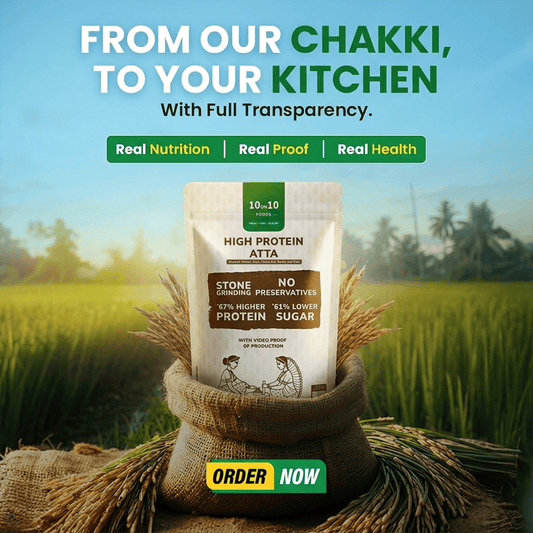
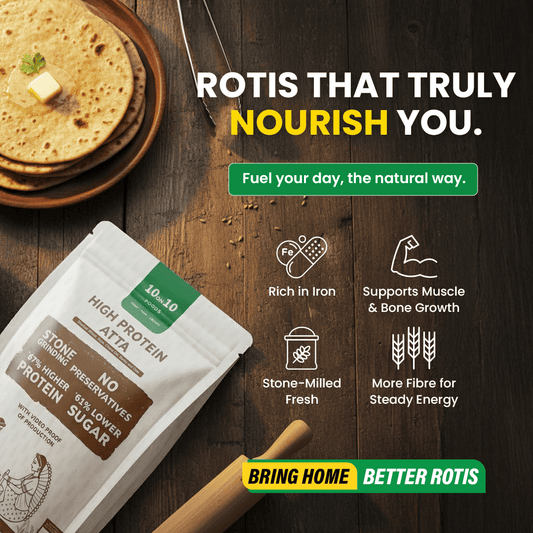
That is why our High Protein Atta is sharbati wheat with soya and chana milled through it, rather than wheat gluten or an isolate stirred in afterwards. Three ingredients, each chosen for what it contributes to the amino acid profile.
What we are not going to claim: we have not had a DIAAS measurement done on the finished blend, so we are not going to print a score for it, and you should be sceptical of anyone who prints one without a lab report behind it. DIAAS is also a score for rating a protein source — it is not a multiplier you apply to grams to get "usable protein", and it cannot be averaged across a blend, because complementation is precisely the effect an average erases. What we can tell you is which constraint the formulation is built to address, and what is declared on the pack.
The jowar trial used 30%, not 100%
Sorghum at 30% of the flour lowered the glucose response — and cut how much people ate at the next meal.
A 2025 randomised crossover trial gave twenty healthy adults pasta made with 30% sorghum flour against a 100% durum wheat control. The red sorghum version produced a significantly lower blood glucose response (−0.35 mmol/l, P = 0.005) and a smaller 120-minute glucose area under the curve (−36.11 mmol/l×min, P = 0.017).
The finding that matters more came afterwards. Participants reported higher satiety (P = 0.029) and lower hunger (P = 0.004), then ate around 794 kJ less at the following meal (P = 0.001) — roughly 190 calories they simply did not eat, hours later, with nobody asking them to restrict anything.
Read the proportion again: thirty percent. This quietly dissolves the oldest objection to millet flours. Everyone is told to eat more jowar, most people attempt a 100% jowar roti once, fight a dough with no gluten in it, and never try again. The trial suggests the all-or-nothing framing was never necessary.
Two honest caveats. The study was done on pasta, not roti, and the comparison was against durum wheat — so the effect size in your kitchen may differ. And twenty people is a small trial. What it establishes is a direction and a workable proportion, not a guarantee.
What the khapli study actually measured
This is the uncomfortable one. Khapli — emmer wheat, Triticum dicoccum — is sold across India, by us included, with a strong implication about blood sugar. So we read the clinical trial that most of those claims trace back to.
In diabetic patients, khapli wheat significantly improved blood lipids. It did not significantly change blood glucose.
Twenty-two people with diabetes ate 200–300g of flour a day as unleavened bread for six weeks, one group on dicoccum (khapli) wheat, one on ordinary bread wheat.
The lipid results were clear. In the khapli group total lipids fell 14% (p<0.01), triglycerides fell 15% (p<0.01) and LDL cholesterol fell 11% (p<0.05). The control group showed no significant lipid change.
Fasting and postprandial glucose, though, did not move significantly. Fasting glucose drifted downward in the khapli group (132.6 → 112.4 mg/dL), but the change did not reach statistical significance, and neither did the postprandial figures.
We are not going to dress that up. If you are buying khapli specifically to bring your blood sugar down, the strongest trial available does not support that claim. It is also a small study from 2001, which cuts both ways — absence of a significant result in twenty-two people is not proof of absence.
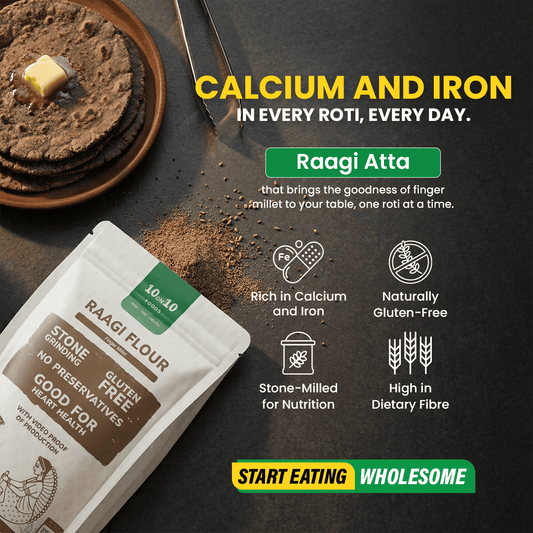
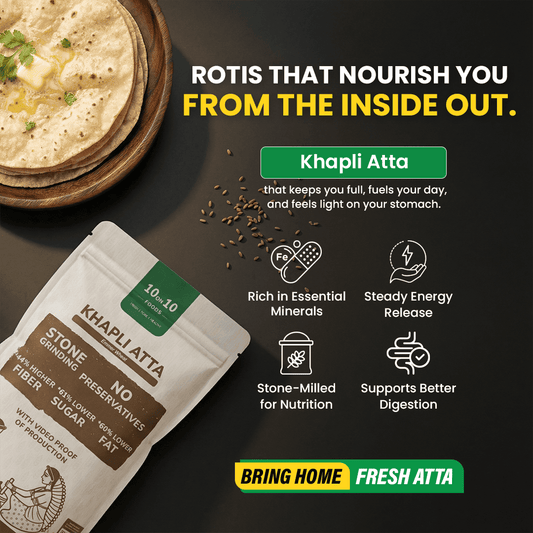
What the trial does support is khapli as a lipid story. A 14% fall in total lipids over six weeks, from changing nothing but which flour went into the same rotis, is a real result and a good reason to eat it. Set alongside our declared figure — 14.54g of dietary fibre per 100g, the highest of anything we mill — khapli earns its place on the shelf. Just for a different reason than the one usually advertised.
"The families who make real progress are almost never the ones who switched to the most expensive flour. They are the ones who changed what is in the jar — a legume in it for the amino acids, some jowar in it for the glucose curve — and went on eating rotis exactly as before."
"If you change one thing this month, do not change your brand. Put a couple of spoons of besan into the atta you already own and give it four weeks. If your family does not notice the difference on the tawa, that is the change working."
Work out what your household actually eats
This calculator uses only our declared pack values and published lab results. Where we have not published a figure, it says so rather than estimating. To compare against what you currently buy, read the protein figure off your present atta's pack and type it in — that way the comparison uses your number, not our guess about it.
The atta calculator
Protein, fibre and monthly cost for your household — from published figures only.
What we would actually do
If you take one thing from three papers, take this: what is in the jar matters more than the name on it.
If you buy nothing from us today, do this anyway — put a couple of spoons of besan into whatever atta is currently in your kitchen. It is cheap, it addresses the amino acid wheat is genuinely short of, and it is the highest-return change available to a household that already eats rotis every day.
If you would rather not run a blending operation in your kitchen every week, that is exactly what a pre-milled blend is for, and it is what we make.
Start with the one that matches your answer
Milled fresh after you order, with a QR code on every pack that shows the video of your own batch. Free shipping above ₹299.
Sources
- Mathai JK, Liu Y, Stein HH. Values for digestible indispensable amino acid scores (DIAAS) for some dairy and plant proteins may better describe protein quality than values calculated using the concept for protein digestibility-corrected amino acid scores (PDCAAS). British Journal of Nutrition, 2017;117(4):490–499. — source for wheat 54%, soya flour 105%, pea protein concentrate 73%, and the limiting amino acid in each.
- Khan J, et al. Effect of sorghum flour-containing pasta on postprandial glycemia, appetite and energy intake in healthy individuals. European Journal of Clinical Nutrition, 2025. — source for the 30% sorghum figures, n=20, pasta.
- Yenagi NB, Hanchinal RR, Patil CS, Koppikar V, Halagi M. Glycemic and lipidemic response to dicoccum wheat (Triticum dicoccum) in the diet of diabetic patients. International Journal of Diabetes in Developing Countries (RSSDI), 2001. — source for the khapli lipid and glucose results, n=22, six weeks.
- FAO. Dietary protein quality evaluation in human nutrition, Food and Nutrition Paper 92 — the report that recommends DIAAS over PDCAAS.
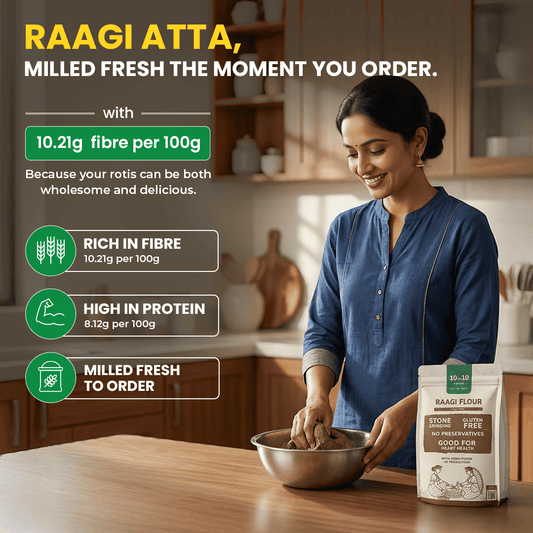
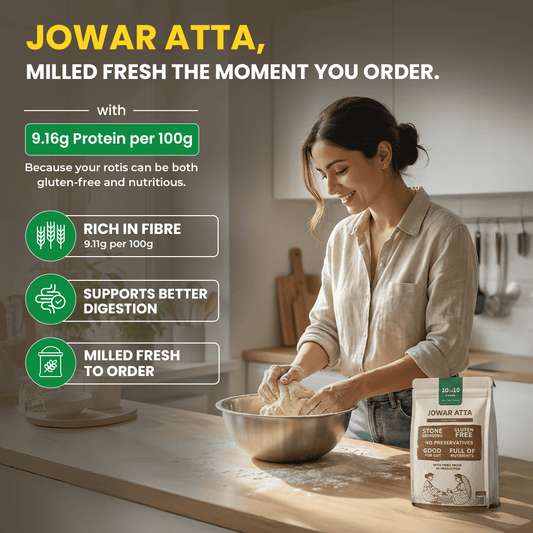
- 10on10 Foods third-party lab reports, tested 6 January 2026 — besan (AGSS/FA/26010600013), jowar atta (AGSS/FA/26010600011), ragi atta (AGSS/FA/26010600012). Published at 10on10foods.com/pages/lab-reports.