
Understanding Macronutrients: The Complete Guide to Indian Flours and Why High-Protein Atta is a Game Changer
MOORAV FOODTECH PRIVATE LIMITED AdminShare
If you grew up in an Indian household, your day will likely start with the sound of the rolling pin hitting the chakla. Food is an emotion in India, but it is also fuel. Food is an emotion in India, but it is also fuel. While we walk behind homely comfort, we often overlook the science behind it. We talk about "heavy" meals or "light" meals, but how often do we talk about macronutrients?
For many years, you must have heard your elders having a conversation that focuses on cutting out oil or reducing sugar. Although these are important, there is a missing balance of nutrients in our staple foods.
This article isn't about counting every calorie or turning your kitchen into a laboratory. Instead, we’ll be decoding the nutritional value of your flour dabba and explaining why shifting to high-protein atta might just be the most effortless health upgrade you can make for your family.
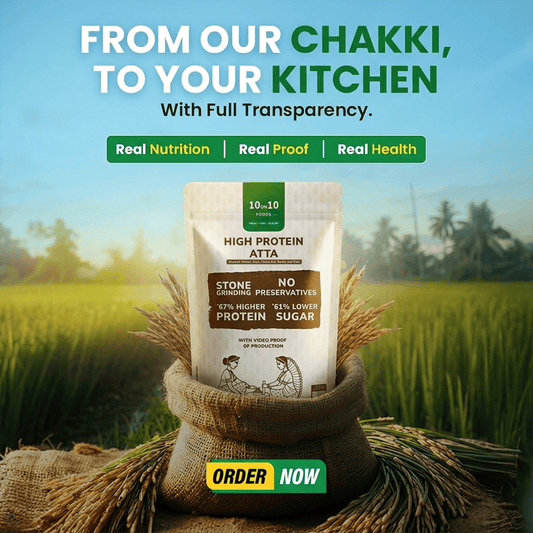
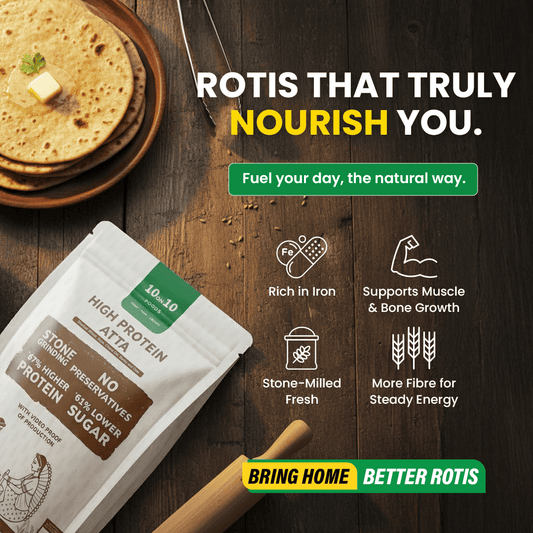
High protein atta, stone-ground fresh
1 kg · 25 g protein per 100 g, contains soyAdd to cart
1 kg · 23 g protein per 100 g, contains soyAdd to cart
Stone-ground only after you order · QR video of your batch on every pack
What Are Macronutrients and Why Do They Matter in Your Daily Roti?
Before we get into details, let us define what "macronutrients” are. To put it simply, these are the nutrients our body needs in large amounts to function correctly. And, those nutrients are:
-
Carbohydrates (Carbs): Carbs are the primary energy source. In an Indian context, this is your roti, rice, poha, and idlis. They fuel your brain and muscles.
- Proteins: These are titled as the “builders”. Proteins are the most satiating nutrient and are important for rebuilding tissues, making enzymes, and keeping your hair and skin healthy.
- Fats: They act as protectors. Fat in the human body supports cell growth, protects organs, and helps absorb nutrients.
The problem with the modern Indian diet is that our macronutrient balance is often skewed. We are generally carbohydrate-heavy and protein-deficient.
Macronutrient Breakdown of Popular Indian Flours (Per 100g Chart)
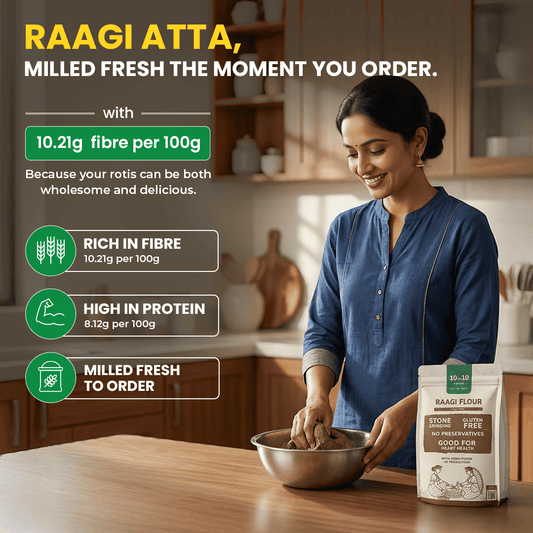
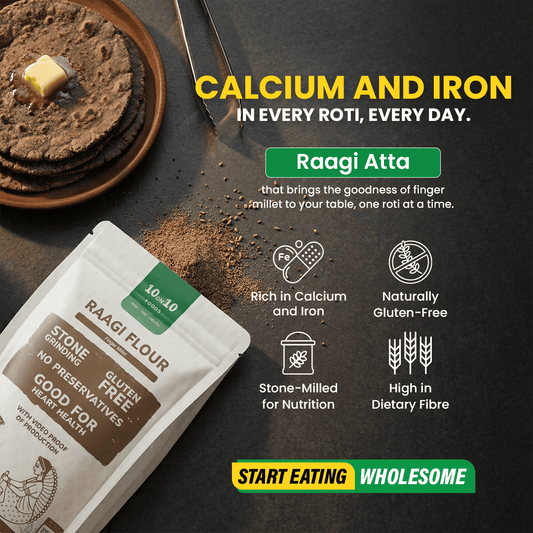
We are blessed with a variety of grains in India. While Whole Wheat Flour (Gehu ka Atta) is the undisputed king of North and Central India, other grains like Jowar, Bajra, and Ragi are superfoods in their own right. But are you aware of the fact that even these superfoods vary significantly in their macronutrient profiles? Yes, that’s true…
Understanding the following nutritional value of these flours helps us see where the gaps lie:
Table 1: Nutritional Value of Common Indian Flours (Per 100g)
|
Flour Type |
Calories (kcal) |
Protein (g) |
Carbohydrates (g) |
Fats (g) |
Fibre (g) |
|
Whole Wheat (Gehu) |
340 |
11 - 12 |
72 |
2.5 |
11 |
|
Bajra (Pearl Millet) |
360 |
11 |
67 |
5 |
11 |
|
Jowar (Sorghum) |
349 |
10 |
72 |
1.9 |
6 |
|
Ragi (Finger Millet) |
328 |
7 |
72 |
1.3 |
11 |
|
Besan (Chickpea Flour) |
387 |
22 |
58 |
6 |
10 |
Note: Nutritional values are approximate averages, plus they vary based on brand and processing methods.
Quick summary of the table:
As you can see, traditional cereals like wheat and millets are excellent sources of energy (carbs) and fibre. Nonetheless, their protein content falls somewhere around 10-12 grams per 100g. At the same time, Besan is high in protein.
Which Indian Flour Has the Highest Protein Content?
Fun Fact: Nearly 73% of urban-rich Indians are protein-deficient.
Why is this happening? Simply because our traditional thalis have shrunk the dal and sabzi portions, but this isn’t the case with the heap of rice or stack of rotis. A typical meal of 3 rotis and a bowl of vegetables provides ample energy but falls short on protein.
Now, how do you know you are having a protein deficiency? You’ll notice symptoms like constant fatigue, hair loss, inability to lose weight, and muscle loss as you age.
Here is a situation: for a vegetarian population, getting enough protein without consuming excessive carbs is a mathematical challenge. So, to get 20g of protein from dal, you might have to consume a significant amount of carbs along with it. Hence, this is where the innovation of high-protein atta becomes a game-changer.
High Protein Atta vs Regular Wheat Atta: Macro Comparison
Imagine if your roti could work twice as hard for your health. Good news, this is what a roti made of high-protein atta promises. The benefits are exceptional, and the best thing is that it is often regarded as a keto-friendly flour.
High-protein atta is not your simple wheat flour. They are scientifically formulated blends. Particularly, it uses a base of whole wheat flour and is fortified with plant-based protein sources such as:
- Soya flour or isolates
- Chickpea flour (Besan) or Sattu
- Pea protein
-
Whey protein concentrates (in some non-vegan variants)
- Seeds like flax, chia, or pumpkin
By tweaking the ingredients, manufacturers or home cooks can easily double the protein content and lower the net carbohydrates. This shift allows you to eat the same familiar food while drastically improving your macronutrient intake.
How Many Carbs, Proteins, and Fats Should You Get From Atta Daily?
In this section, we’ll be putting them side-by-side to understand where the difference lies.
Table 2: Regular Atta vs. High-Protein Atta (Per 100g)
|
Nutrient |
Regular Whole Wheat Atta |
Typical High-Protein Atta |
The Impact |
|
Protein |
12g |
20g - 28g |
Double the protein for muscle repair and satiety. |
|
Carbohydrates |
72g |
45g - 55g |
Lower carbs and reduce glucose spikes. |
|
Fiber |
11g |
14g - 16g |
High fibre helps with digestion and gut health. |
|
Glycemic Index |
Medium (55-65) |
Low (< 50) |
Helps manage blood sugar levels. |
So, when you switch to a high-protein variant, you are adding extra protein to your daily diet and enhancing the nutritional profile of your meal.
For instance:
In a practical scenario, if you eat 3 rotis made from high-protein atta, you might be consuming the protein equivalent of having an extra bowl of dal or two egg whites, without the extra cooking effort.
Health Benefits of High-Protein Atta
Here is how protein-rich atta can positively impact your health:
- Sustained Satiety (Feeling Full): Protein takes longer to digest than carbohydrates, so rotis made from high-protein flour keep you full for longer. And you no longer need to snack on biscuits or namkeen between meals.
- Better Blood Sugar Management: High-protein atta is highly beneficial for diabetic individuals. Why? The lower carbohydrate content and higher fibre mean a slower release of sugar into the bloodstream. Ultimately, it prevents those post-lunch energy crashes.
- Weight Management: Protein has a high "Thermic Effect of Food" (TEF), meaning your body burns more calories digesting protein than it does digesting fats or carbs. Combined with satiety, this naturally supports weight loss efforts.
- Muscle Preservation: As we age (especially after 30), we naturally lose muscle mass (sarcopenia). A diet higher in protein helps preserve lean muscle mass, keeping your metabolism active.
How to Switch to High Protein Atta Without Changing Your Recipes
The beauty of this change is that it doesn't require you to learn new recipes. You are still making rotis as you did earlier. Hence, you are just changing the dust in the container.
High-protein flours behave slightly differently from typical wheat flour. If it is your first time rolling rotis made of high-protein atta, here are some tips to get the best results:
- The Transition Mix
We understand that the taste of pure high-protein flour feels too dense initially. To start with, you can combine 50% regular whole wheat flour with 50% high-protein atta. Thereafter, gradually increase the proportion of the high-protein variant as your palate adjusts. It’s that easy!!!
- More Water for Kneading
Protein absorbs more water than starch. So, when kneading high-protein atta, try to add more water to get a soft dough. Next, let the dough rest for at least 20-30 minutes so the fibre and protein can hydrate fully. Ultimately, this ensures your rotis remain soft.
- Cook on Low Flame
Chances are, you might end up burning your rotis. Why? High-protein flours can brown faster than regular wheat. However, you are recommended to cook your rotis on a medium-low flame to ensure they cook through the inside without burning on the outside.
Pro Tip 💡: Don’t limit this flour to just rotis. You can use high-protein atta to make chillas (pancakes), healthy baked crackers (mathri), or even as a binding agent for tikkis.
Conclusion: A Small Shift for a Healthier Tomorrow
In the landscape of Indian nutrition, we often look for complex solutions—fancy diets, expensive supplements, or entirely cutting out our favourite foods. But sometimes, the most effective solution is sitting right in our kitchen pantry.
Understanding macronutrients empowers you to make better choices. You don't have to give up your beloved roti to be healthy; you just need to upgrade it. By acknowledging the protein gap in our traditional diets and embracing high-protein atta, you are taking a massive step toward better metabolic health, energy levels, and long-term wellness.
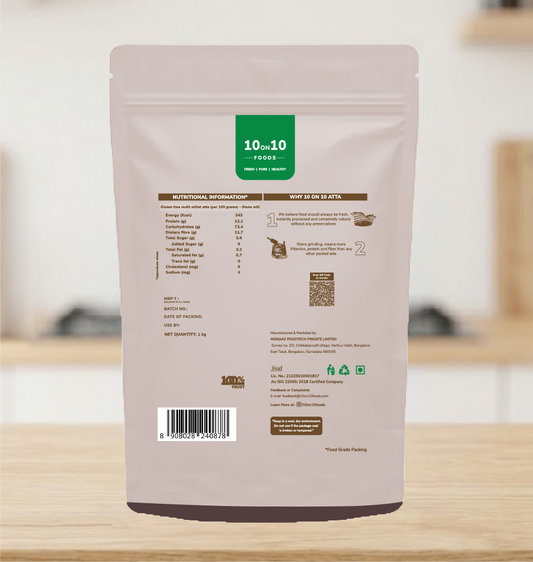
So, the next time you go grocery shopping, flip the packet around. Look at the label. Choose a flour that feeds your muscles as well as your hunger. It’s a simple game changer, but one that your body will thank you for.
Frequently Asked Questions About Macronutrients in Indian Flours
What are macronutrients in Indian flours?
Macronutrients are the three nutrients your body needs in large amounts: protein, carbohydrates, and fat. In Indian flours, the macro profile varies widely — regular wheat atta delivers around 10–12g protein and 70g carbs per 100g, while high protein atta provides 24g+ protein, making it a better choice for balanced daily nutrition.
Which Indian flour has the highest protein content per 100g?
Among everyday Indian flours, high protein atta tops the list with around 24–25g protein per 100g, followed by besan (chickpea flour) at ~22g, soya flour at ~37g, and ragi at ~7g. 10on10 Foods' High Protein Atta delivers 24.56g protein per 100g, blending Sharbati wheat, soya, and channa.
How much protein is in one roti made from high protein atta vs regular atta?
A standard roti uses about 35g of flour. Made from regular wheat atta, it gives roughly 3–3.5g of protein. The same roti made from high protein atta delivers around 8–9g of protein — nearly triple. Eating 3 rotis daily adds 16–17g extra protein with zero recipe changes.
Is high protein atta good for weight loss and muscle building?
Yes. High protein atta supports weight loss by increasing satiety, reducing snacking, and stabilising blood sugar through slower digestion. For muscle building, it provides essential amino acids like leucine that aid muscle repair and growth — making it a practical daily protein source for active adults, gym-goers, and seniors.
Which atta is best for diabetics based on macronutrients?
For diabetics, low glycemic index (GI) flours like besan, jowar, ragi, and bajra are ideal — they release glucose slowly and prevent blood sugar spikes. High protein atta also helps because protein and fibre together slow carbohydrate absorption. Blending low-GI millet flours with high protein atta gives the best macro balance for diabetic-friendly rotis.