Is Khapli Atta Better for Diabetes? Whole Wheat vs Emmer Wheat Compared
MOORAV FOODTECH PRIVATE LIMITED AdminShare
Meera's husband looked at the sugar monitor again. "Again high?" She'd been rolling the same wheat chapatis her mother taught her, never once wondering if the atta itself was part of the problem. It wasn't until she came across the Glycemic Index of Flours that she learned not all rotis behave the same way in the body.
This is the same question a lot of you are asking in a different form: khapli atta vs whole wheat atta — which one actually matters for blood sugar? Here's the honest, number-backed answer.
Khapli vs Whole Wheat: What's Actually Different?
Whole wheat atta (what most Indian households use daily) comes from modern hybrid wheat — bred over decades for higher yield and softer, fluffier rotis. It's a genuinely good everyday flour. But "modern" and "bred for yield" also means it's higher in gluten and digests faster than older wheat varieties.
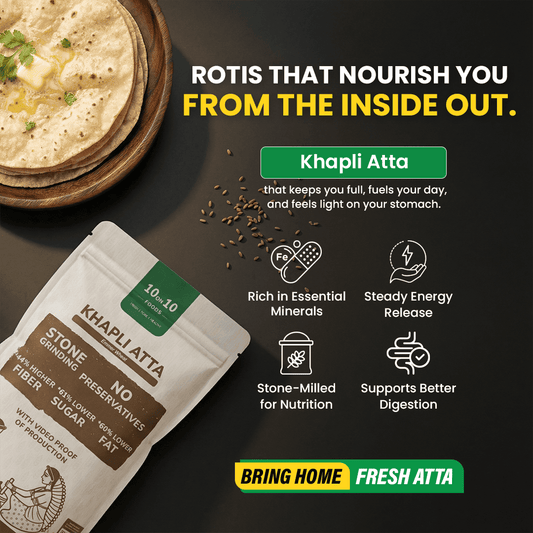
Khapli atta comes from Emmer wheat (Triticum dicoccum) — one of the oldest cultivated wheat varieties in India, largely unchanged for thousands of years. It's not gluten-free, but it carries meaningfully less gluten, more fibre, and digests more slowly.
The GI Number That Actually Matters
| Flour | Glycemic Index (Approx.) | What it means |
| Whole Wheat Atta | ~71 | Digests fast — quicker glucose release |
| Khapli Atta | ~45–50 | Digests slowly — steadier blood sugar |
That's roughly a 30% lower glycemic index for Khapli — the same figures we publish in our own Glycemic Index of Flours guide. A lower GI means the flour releases glucose into your bloodstream more slowly, which matters directly if you're managing diabetes, prediabetes, or just trying to avoid the 4pm energy crash.
This is general nutrition information, not medical advice — always check with your doctor on what fits your specific diet plan.
Full Comparison: Khapli vs Whole Wheat Atta
| Aspect | Whole Wheat Atta | Khapli Atta |
| Glycemic Index | ~71 (higher) | ~45–50 (lower) |
| Gluten | Higher | Lower (not gluten-free) |
| Fibre | Good | Higher |
| Digestibility | Can feel heavy for sensitive digestion | Generally gentler on the gut |
| Texture | Soft, fluffy rotis | Slightly denser, nuttier flavour |
| Best for | Everyday soft rotis, kids' tiffins | Diabetic-friendly meals, sensitive digestion, weight management |
Why This Matters for Diabetics Specifically
One of our own customers, Ramesh, was managing type 2 diabetes when he switched to Khapli and besan atta. Within weeks, his sugar readings stabilised and he felt more energetic through the day — a small, deliberate change in what's already a daily habit, not a diet overhaul.
That's really the point of the GI difference: you don't have to give up roti. You just have to be thoughtful about which atta is doing the work every single day, since it's a meal you're eating multiple times a week, not an occasional indulgence.
Should You Switch Completely?
Not necessarily — and we won't pretend otherwise. Khapli is denser and has a stronger, nuttier flavour than whole wheat, so if your family is used to soft, neutral rotis, a full switch can be a big change. A practical middle path:
- Start with a 50:50 blend of Khapli and your regular wheat atta for 2–3 weeks
- Increase the Khapli ratio gradually as your family's palate adjusts
- Go fully Khapli once you're comfortable with the texture and taste
Why Freshness Matters Here Too
Whatever atta you choose, freshness changes the nutrition math. Flour that's sat in a warehouse for weeks loses fibre and nutrient density regardless of which grain it started as. Our Khapli Atta is stone-ground and milled only after you place your order — no chemicals, no preservatives, with video proof of every batch.
Try our stone-ground Khapli Atta (Emmer Wheat Flour)
FAQs
Q1. Is Khapli atta really better for diabetics than whole wheat?
A1. Khapli's lower glycemic index (~45–50 vs ~71 for whole wheat) means slower glucose release, which supports more stable blood sugar. It isn't a medical treatment — check with your doctor on how it fits your specific diet.
Q2. Does Khapli atta taste very different from whole wheat?
A2. Yes — it's denser with a nuttier, earthier flavour, compared to the softer, milder taste of regular whole wheat rotis. Many people start with a 50:50 blend to ease into it.
Q3. Is Khapli atta gluten-free?
A3. No. It has meaningfully less gluten than modern wheat, but it isn't safe for celiac disease or full gluten intolerance.
Q4. Can I replace whole wheat atta entirely with Khapli?
A4. Yes, many people do — though we'd suggest transitioning gradually (50:50 for a few weeks) since the denser texture and stronger flavour take some getting used to.
Q5. Where does the GI data for these attas come from?
A5. These are the approximate glycemic index figures we publish in our own Glycemic Index of Flours guide, consistent across our site.