
5 Simple Flour Swaps That Can Transform Your Family's Nutrition
MOORAV FOODTECH PRIVATE LIMITED AdminShare
Every morning, across millions of Indian households, a familiar ritual unfolds. It goes like this: atta is kneaded, the tawa heats up, and hot rotis are stacked for the family.
Why not? It is comforting. It is traditional. But, here is the truth:
It is quietly working against their health because the flour you choose every day for your chapatis, parathas, and rotis directly shapes the long-term health of every family member.
The average Indian family uses the same bag of plain wheat flour year after year while rarely questioning whether it is the healthiest choice. And the fact that even the ‘nutritional value of wheat flour’ lacks the nutritious variety our ancestors enjoyed when they rotated millets, legumes, and whole grains seasonally.
And in this guide, you will find 5 kitchen-tested flour swaps that are easy, affordable, and genuinely transformative for your family’s health.
Shop all 5 swaps, milled fresh
1 kg · naturally gluten-free, rich in calciumAdd to cart
1 kg · naturally gluten-free grainAdd to cart
1 kg · naturally gluten-free, a winter stapleAdd to cart
500 g · stone-ground from whole chanaAdd to cart
1 kg · eight grains, still rolls a soft rotiAdd to cart
Stone-ground only after you order · QR video of your batch on every pack
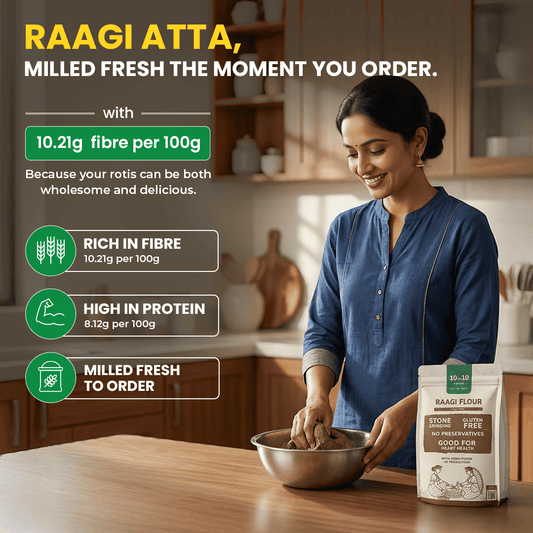
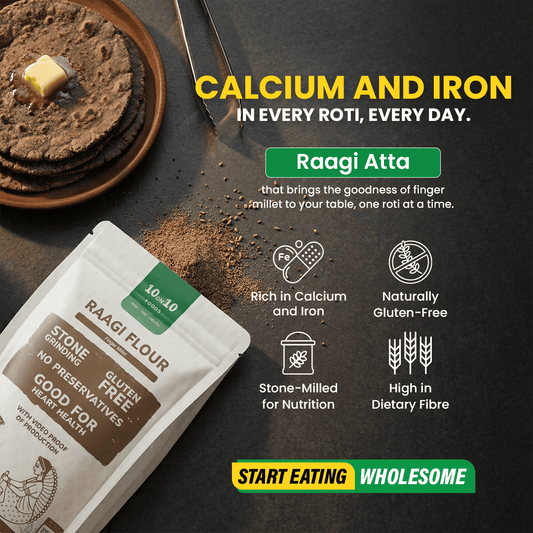
Swap 1: Replace 30–50% of Wheat Flour with Ragi (Finger Millet) Atta
Ragi, or finger millet, is one of India’s most underrated nutritional grains. It has long been a staple grain of Karnataka, Andhra Pradesh, and Tamil Nadu, and ragi has been quietly nourishing generations of South Indians.
Ragi stands apart from almost every other grain flour for the following reasons:
| Nutrient / Property | Value / Benefit | Best Used For |
| Calcium | ~344 mg per 100g | Bone health and development |
| Low Glycemic Index (GI) | GI of approximately 50 | Blood sugar management and diabetic-friendly diets |
| Natural Appetite Control | The amino acid tryptophan in ragi keeps the stomach full longer. | Weight management (keeps the stomach full longer) |
| Rich in Iron | Ideal for combating iron-deficiency anaemia. | Combating iron-deficiency anemia and boosting hemoglobin |
| Gluten-Free | A naturally gluten-free grain, suitable for people with gluten sensitivity. | Gluten-sensitive diets (our ragi is milled in a facility that also handles wheat) |
| Fiber Content | ~12g per 100g | Healthy digestion and gut health |
How to Use Ragi at Home
- Mix 30–50% ragi flour with regular wheat atta for everyday rotis; the taste is nutty and slightly earthy.
- Use for ragi mudde (Karnataka’s traditional balls), ragi dosa, porridge, or even ragi ladoos.
- Add to children’s pancakes and cheelas for a nutritious breakfast.
Swap 2: Introduce Jowar (Sorghum) Atta for Gut Health and Immunity
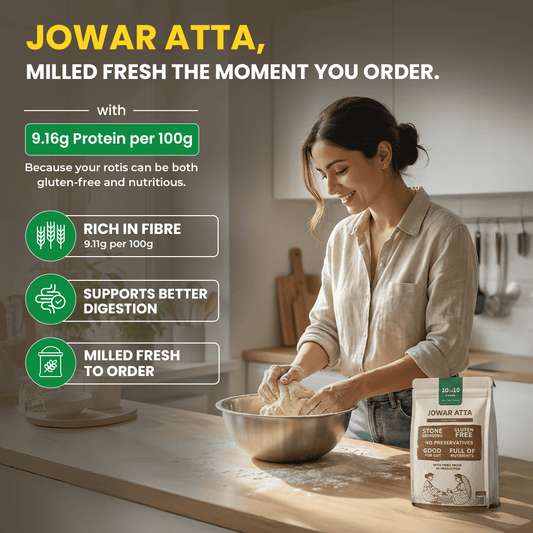
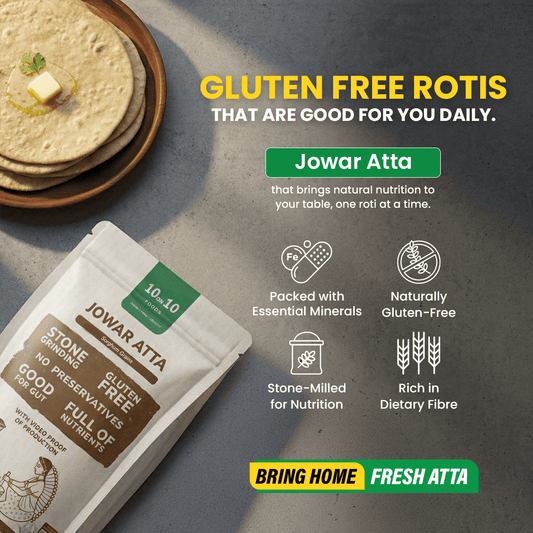
Jowar, or sorghum, was once a daily staple in Maharashtra, Rajasthan, and Karnataka. Today, it has been largely displaced by wheat. Unlike the nutritional value of wheat flour, it contains rare antioxidants found specifically in the bran layer that have been linked to cancer prevention in emerging research.
Here is how you can use it at home:
- You can use jowar flour for traditional bhakri (unleavened flatbread). This is mostly popular in Maharashtra and Karnataka.
- Blend 30% jowar into your regular atta mix for everyday rotis.
- Use in soups and stews as a thickener for an invisible nutritional upgrade.
Swap 3: Add Bajra (Pearl Millet) Atta for Heart Health and Weight Management
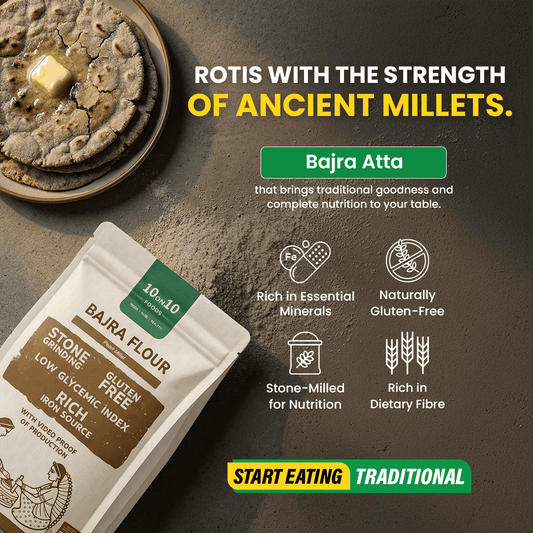
Bajra roti with butter and jaggery is comfort food across Rajasthan, Gujarat, and Maharashtra. But beyond its beloved taste, bajra (pearl millet) carries one of the most impressive nutritional profiles of any grain available in an Indian kitchen.
When families ask for the best atta for weight loss, bajra’s combination of complex carbohydrates, high fibre, and low glycaemic index makes it one of the most scientifically supported choices for managing weight through your daily meals.
How to Use Bajra at Home
- Make traditional bajra roti (thicker than wheat roti) served with mustard greens, dal, or ghee.
- Blend 25–40% bajra flour into your regular atta mix for daily rotis.
- Use bajra flour in khichdi, ladoos, and even bajra-oat pancakes for children.
Swap 4: Use Besan (Chickpea Flour) for Protein, Blood Sugar Control, and Skin Health
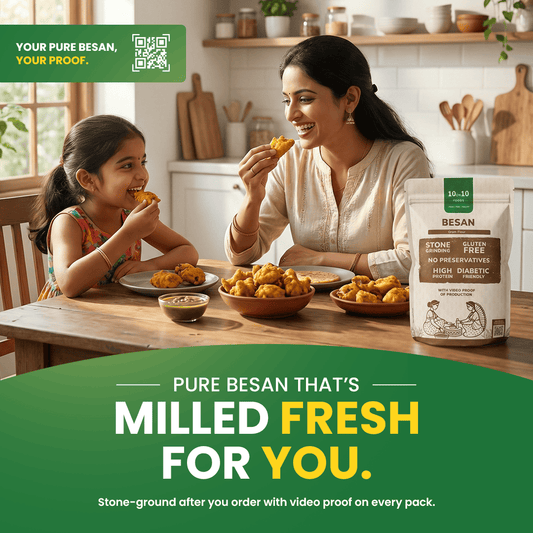
Besan is made from ground Bengal gram (chana) and carries one of the highest protein contents of any commonly available Indian flour. It is a nutritional overachiever that most families dramatically underutilise.
The nutritional content in besan is exceptionally high. For instance, it has ~22g of protein per 100g, is high in iron, potassium, copper, zinc, phosphorus, and folate. In addition, besan has a very low glycemic index to help stabilise blood sugar levels. And the best part is that besan actively supports cardiovascular health and is the best atta for weight loss.
How to Use Besan at Home
- Make besan cheela (savoury pancakes with onions, tomatoes, and spices) for breakfast. It gets ready in under 10 minutes.
- Use as a 20–30% blend in regular atta for rotis with extra protein.
- Use in kadhi, pakoras, dhokla, and sev. These are the dishes already beloved in Indian households.
- Mix into baby food and porridges for toddlers who need protein-rich complementary feeding.
Swap 5: Upgrade to Multigrain Atta for the Most Comprehensive Daily Nutrition
If the previous four swaps feel like too many changes at once, multigrain atta is the simplest solution. It requires just a single upgrade that combines the benefits of multiple grains in one bag. For example, it includes wheat, jowar, bajra, ragi, barley, oats, and sometimes flaxseeds or soya.
Altogether, it creates a flour rich in fibre, vitamins, minerals, and protein compared to any single-grain option.
How to Use Multigrain Atta at Home
- Use directly as a 1:1 replacement for regular wheat atta for all rotis, parathas, and theplas.
- Use in multigrain pancakes, waffles, and banana bread for children.
- Mix with yoghurt for overnight-soaked multigrain dosas.
The 5 Flour Swaps at a Glance: Quick Comparison
Here are the key comparisons for a quick overview:
| Flour | Key Benefit | Best For | GI | Gluten-Free? |
| Ragi | Calcium + Iron | Children, bone health | ~50 | Yes |
| Jowar | Immunity + Gut | Heart, digestion | ~55 | Yes |
| Bajra | Weight + Heart | Best atta for weight loss and diabetes | ~50 | Yes |
| Besan | Protein + Blood Sugar | Vegetarians, diabetics | ~35 | Yes |
| Multigrain | All-round nutrition | Entire family | ~45–52 | Varies |
Conclusion: One Swap at a Time, One Healthier Family
By now, it is clear that you do not need to change everything at once. You do not need to spend more money. You do not need to discard your family’s favourite recipes. All you need is the willingness to make one small swap and let that first step build into a lasting nutritional transformation.
Begin with ragi for your children’s bones, then add bajra for your own weight goals. If your family member is protein-deficient, then bring besan back for protein. Meanwhile, let jowar look after the gut. All combined, the multigrain way meets your overall health goals.
FAQs
Q1: What is the best atta for weight loss?
A: Bajra (pearl millet) and Besan (chickpea flour) are excellent choices for weight loss due to their low glycemic index, high fiber content, and complex carbohydrates that keep you full longer.
Q2: Can I completely replace wheat flour with Jowar atta for daily cooking?
A: Yes, absolutely! Jowar (sorghum) was traditionally used as a primary daily staple in many parts of India. It works beautifully for traditional flatbreads like bhakris. However, because Jowar is completely gluten-free, the dough lacks stickiness; if you find it hard to roll into regular rotis, you can ease into it by blending 30% Jowar flour with your regular wheat atta.
Q3: How can I improve my family's daily nutrition without changing our entire menu?
A: The easiest way to upgrade your family's nutrition is by making small, gradual swaps in your daily atta. Instead of using 100% plain wheat flour, try replacing 30% to 50% of it with nutrient-dense alternatives like Ragi (for calcium and iron) or Besan (for a protein boost). This allows you to stick to your usual daily meals while quietly multiplying their nutritional value.
Q4: Why should I switch to Multigrain atta instead of single-grain flours?
A: If managing multiple different flours feels overwhelming, Multigrain atta is the perfect all-in-one solution. It combines the unique health benefits of various grains—such as wheat, jowar, bajra, ragi, and oats—into a single bag. This gives your family a comprehensive dose of protein, vitamins, and minerals in every single roti without changing your kitchen routine.