
Protein in Wheat Flour (Per 100g) – Full Breakdown
MOORAV FOODTECH PRIVATE LIMITED AdminShare
Quick answer: Whole wheat atta contains 11–14g of protein per 100g — more than refined maida (9–10g) and jowar (10–11g), but less than khapli/emmer wheat (14–15g) or besan (22–23g). Full breakdown by variety and milling type below.
Want more protein per roti?
1 kg · 25 g protein per 100 g, contains soyAdd to cart
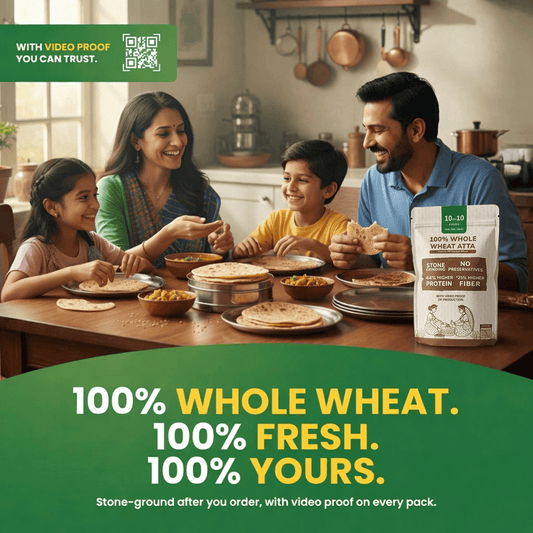
Stone-ground only after you order · QR video of your batch on every pack
If you think back to your grandmother's kitchen, you will remember a kind of wisdom that didn't come from books or labels but from years of living close to nature. She never once checked a packet to see how much protein the flour contained, never compared brands, and never spoke about "nutrition science." Yet somehow, her rotis had more strength, more flavour, and more nourishment than anything we buy today. She knew, without ever articulating it, that the soul of good food lies in its freshness.
Her mornings often began with the sound of grains being cleaned, sun-dried or carried to the local chakki. Flour wasn't something that stayed in cupboards for months - it was something that was used while it was still alive. She didn't know the biochemical explanation behind it, but she always said the same thing: "Naya pissa hua atta hi shareer ko taqat deta hai." Freshly milled flour gives real strength. And she was right in more ways than she ever realised.
Science has finally caught up with her instinct today. We now know that the true power of wheat does not lie in its colour, texture, or softness but in the protein it naturally carries-the same protein that supports muscles, digestion, immunity, growth, and overall well-being. But the part she knew intuitively is what most of us overlook today is this, protein stays intact only when the flour is fresh. The moment wheat gets milled, its nutrients start to fade, and industrial heat weakens them. Long storage drains them. Chemicals and refining strip away the things that give flour its natural strength.So while our grandmothers never said words like "gluten-forming proteins" or "bioavailability," they lived by principles that protected exactly those things. They believed in food that it's made the right way. I mean simple, pure, close to nature, and consumed at the right time. And that is where the difference lies between the atta they used and the atta most families bring home today.
Before you get into the nutrition and science behind wheat flour protein, it helps to remember that, Our grandmothers fed the generations with nothing but fresh grains, traditional milling, and faith in nature, long before we knew the scientific reasons behind her doing so. And now, as we return to fresher methods of milling, we're not just improving nutrition, but also we're only now discovering what they knew all along.
Wheat Flour Protein Content - Why It Differs
Most packaged flours available in supermarkets have already lost a significant portion of nutrients due to:
- Long storage in warehouses
- Excessive heat in industrial milling
- Refining and chemical treatment to boost shelf life
As a result, even though the packet may claim a certain wheat flour protein content, the actual nutrition the body receives is much lower. This is because proteins and enzymes in flour begin to break down within days of milling.
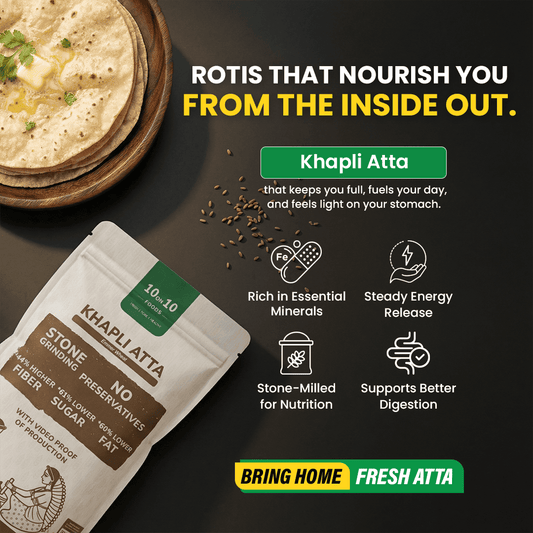
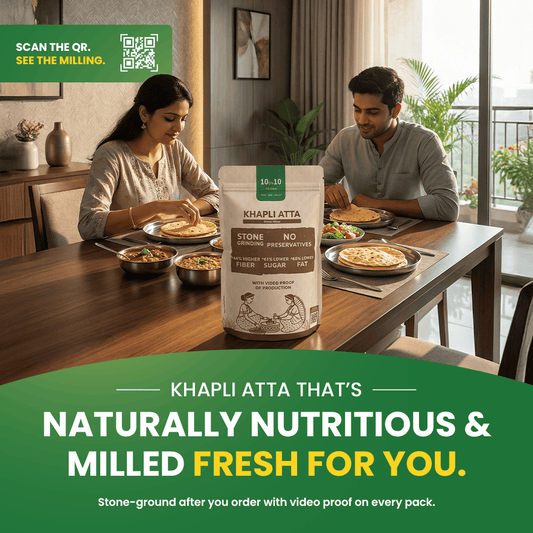
Protein content also varies by wheat variety: Sharbati wheat (grown mainly in Madhya Pradesh) typically runs 11–12g per 100g, Lokwan around 10–11g, Durum wheat 12–13g, and Khapli (Emmer) wheat noticeably higher at 14–15g — one reason we mill Khapli separately for customers specifically seeking a higher-protein wheat option.
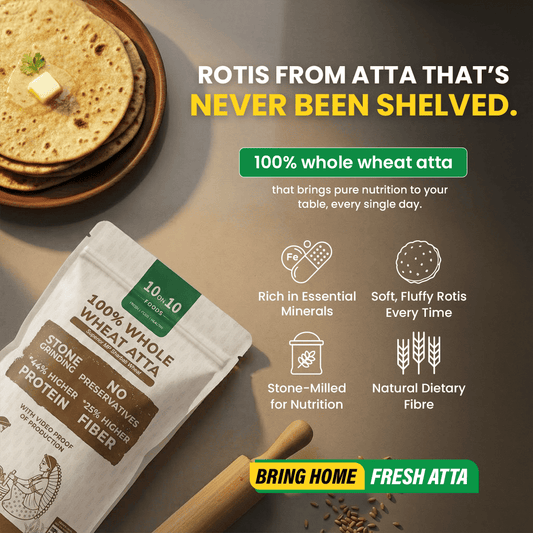
Milling method matters just as much as variety. Stone-ground (chakki) milling works at low speed and low heat, which keeps the wheat germ and bran — and the proteins bound to them — largely intact. Roller-milling, used by most large commercial producers, runs at much higher speed and generates more heat, which denatures a portion of the protein and separates out bran that often isn’t added back. That’s a purely technical, milling-method difference, not a claim about any specific brand.
This is also why packaged flour on a shelf for weeks or months can show lower bioavailable protein than the same variety milled fresh: proteins and enzymes begin breaking down once the grain is crushed and exposed to air, heat and time, regardless of what the packet label states.
Nutrition Breakdown - Protein in Wheat Flour
Below is a simplified nutritional comparison between freshly milled whole wheat flour and store-bought pre-packed flour:
| Flour Type | Protein per 100g | Primary Protein Type |
| Whole Wheat Flour (atta) | 11-14g | Gluten (gliadin + glutenin) |
| Refined Wheat (maida) | 9-10g | Gluten (lower bran protein) |
| Khapli/Emmer Wheat | 14-15g | Ancient gluten variant |
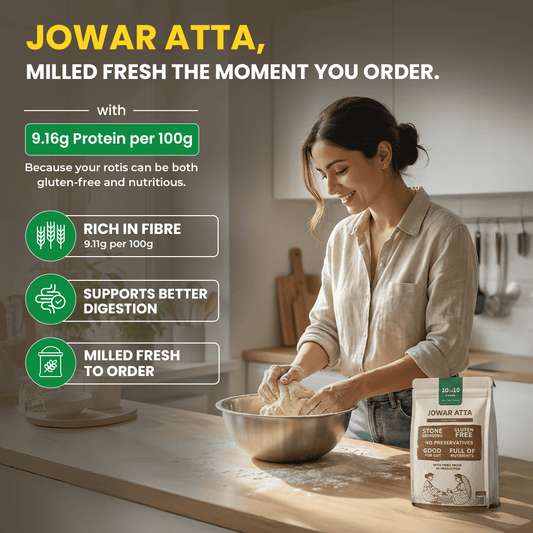
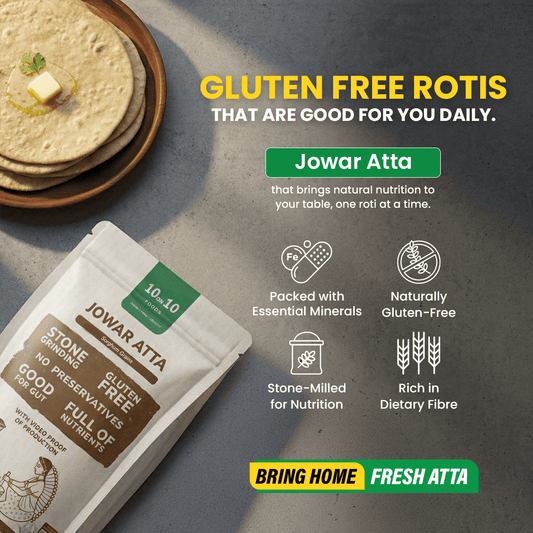
| Jowar Flour | 10-11g | Kafirin (gluten-free) |
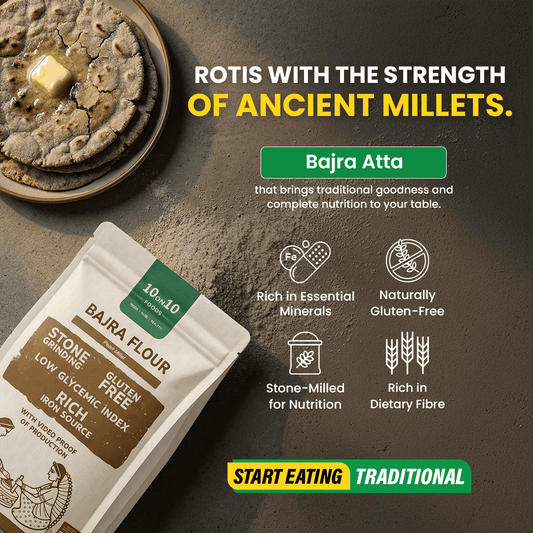
| Bajra Flour | 11-12g | Pennisetin (gluten-free) |
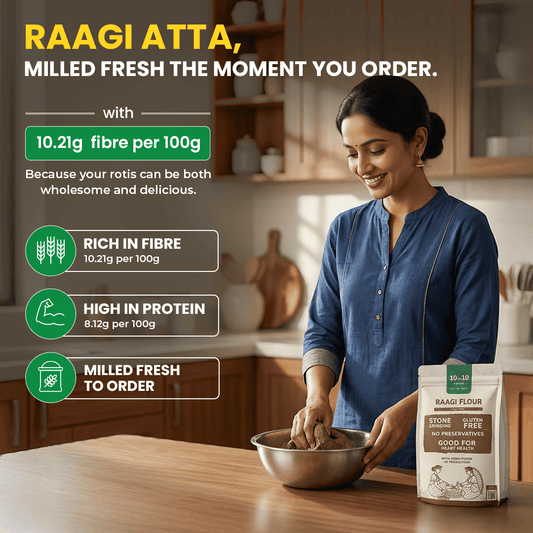
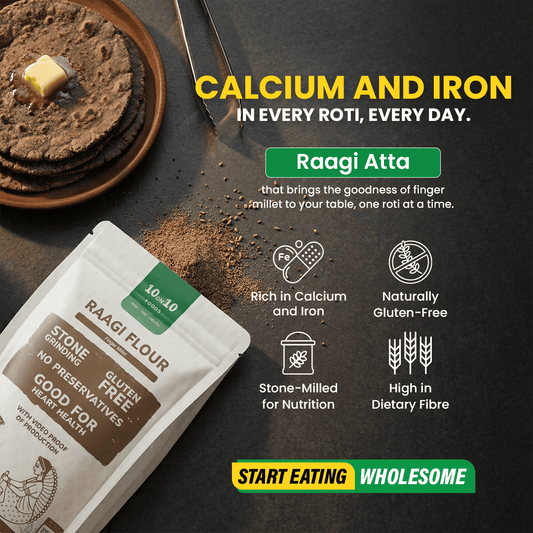
| Ragi Flour | 7-8g | Eleusinin |
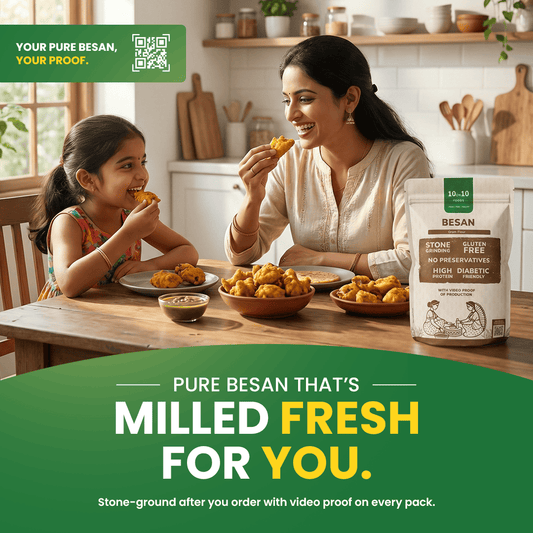
| Besan (Chickpea) | 22-23g | Legumin & vicilin |
The table clearly shows how milling and freshness significantly influence wheat flour protein content and overall nutrition as well.
How Protein in Wheat Flour Supports Your Health
Protein is not just for athletes, it supports every member of the family. The proteins present in flour are called gluten-forming protein and deliver several benefits:
Fresh, high-quality protein in wheat flour helps support:
Gluten (gliadin + glutenin) makes up roughly 80% of wheat's total protein. Together, gliadin gives dough its stretch and glutenin gives it strength — the combination is what lets roti dough be rolled thin without tearing.
Albumin and globulin, the water- and salt-soluble proteins, make up most of the remaining ~15%. They don't contribute to dough elasticity, but they carry a meaningful share of wheat's essential amino acids.
This is also why gluten matters for dough elasticity: without enough intact gliadin and glutenin, dough tears instead of stretching — which is part of why freshness and gentle milling (not just protein grams on a label) affect how your roti actually behaves in the kitchen.
One gap worth knowing about: wheat protein is naturally low in lysine, an essential amino acid. This is exactly why traditional Indian thalis pair roti with dal, rajma or chana — legumes are rich in lysine, and eating the two together gives your body a more complete amino acid profile than wheat alone.
By the same logic, wheat protein's PDCAAS score (a standard measure of protein quality, on a 0–1 scale) sits around 0.4–0.5 on its own — middling by that metric precisely because of the lysine gap above. Combined with legumes, the effective score rises meaningfully, which is the science behind a food pairing your grandmother never needed a lab to figure out.
These benefits are found only when the flour is in its natural state, chemical-free, and freshly milled and not sitting in some warehouse for months.
The 10on10 Foods Commitment
Food should nourish, not just fill. With 10on10 foods flour, you get:
- Freshly milled flour every time
- Full preservation of natural protein in wheat flour
- Traditional stone milling keeps fiber and minerals intact.
- Eco-friendly and refillable packaging
- No shortcuts, no storage, no compromise-just the best of nature as it should be.
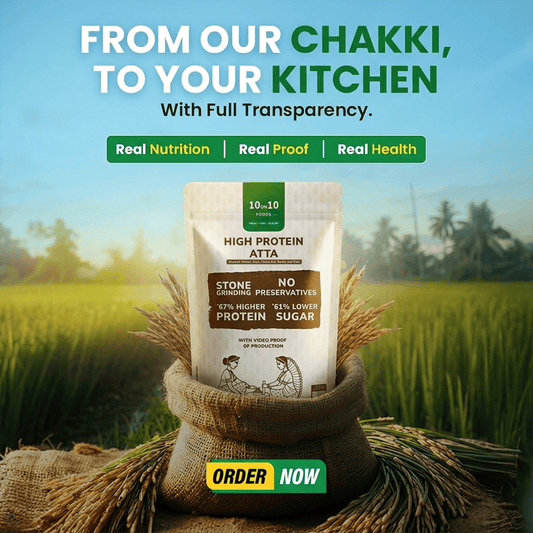
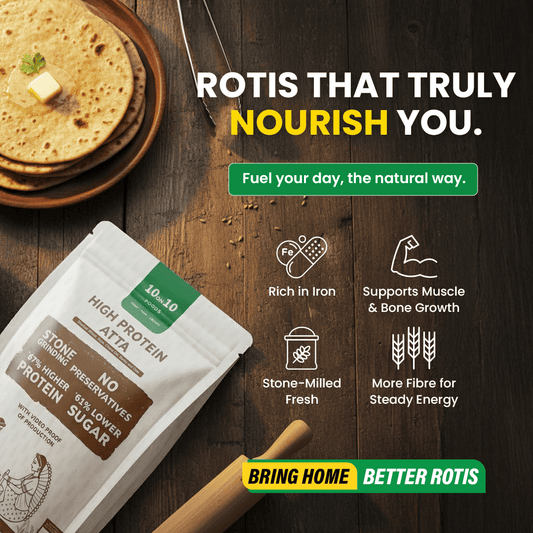
Looking for higher-protein alternatives to regular wheat flour? See our High Protein Atta (24.56g protein per 100g) or Khapli Atta (14-15g protein per 100g).
Want the full range? Browse our Everyday Protein collection, or try besan for another naturally high-protein, gluten-free flour — both stone-ground and milled fresh after you order.