
India Eats Atta Every Day, But Does It Deliver Enough Protein?
MOORAV FOODTECH PRIVATE LIMITED AdminShare
Recently, India has had a protein moment. Fitness subreddits, government think tanks, hospital nutrition departments, and celebrity wellness accounts, everybody is suddenly talking about the same thing.
At the same time, despite a debate that Indian food is mostly carbs, experts or nutritionists say that a little planning can enable Indian households to meet their protein needs. Over the past decade, India’s protein intake has grown slightly, but it is still adequate.
|
A Quick Look at Statistics: Between 2011–12 and 2023–24, it was found that an average daily per-capita protein intake in rural areas increased from 60.7 g to 61.8 g and from 60.3 g to 63.4 g in urban areas (according to the Council on Energy, Environment, and Water) |
Now the question arises, “Why Indian diets lack protein?” Well, the answer is linked to long-standing structural patterns in Indian eating habits. Plus, leafy vegetables remain critically under-consumed by both vegetarians and non-vegetarians. Therefore, protein is something that every Indian should fall for.
The comprehensive blog post will walk you through everything you need to know about protein intake.
Significance of Protein for Metabolic Health
Protein is not just about gym gains. It is one of three macronutrients, along with fats and carbohydrates. Scientifically, it is considered your body’s key building blocks since it supports your cells, organs, and tissues.
Even though, in a few clinical trials, it has been found that consuming more protein than the specified dietary allowance shows beneficial results. For instance, it reduces body weight (BW) and enhances the body composition by lowering fat mass while preserving fat-free mass (FFM) in both low-calorie and standard-calorie diets.
Overall, it is important for every process that keeps the body functioning in the optimal state. Moreover, proteins in the human body form enzymes that help with digestion, repair cells, support hormone balance, and maintain lean muscle mass.
On the contrary, when protein intake is insufficient or low in quantity, muscle tissue starts gradually breaking down, reducing the body’s calorie-burning capacity even at rest.
How Much Protein Does Your Body Actually Need?
There is no definite answer to this question, but nutritionists recommend that it depends on a person’s age, body weight, activity level, and overall health. Meanwhile, the Indian Council of Medical Research (ICMR) issued a study where they suggested, “an average healthy adult would require about 0.8 to 1 gram of protein per kilogram of body weight per day”.
This will straight up mean: If your weight is 65kg, then you’ll require 52–65 grams of protein daily.
An important note: Individuals involved in physical activities (athletes or fitness enthusiasts), pregnancy, recovery from illness, or muscle-building require a higher protein intake than the recommended ratio.
Now, the fact is that many Indians consume far less than this recommended amount. What could be a reason behind it? Indian diets derive about 62% of calories from carbohydrates. Consequently, those who appear well-fed may be protein-deficient at a cellular level.
Are We Still Stuck in a Carbohydrate Trap?
The answer is yes! As stated above, Indian diets derive about 62% of calories from carbohydrates, where foods like rice, rotis, potatoes, poha, idlis, and dosa dominate the plate. There is no denial that these foods are important energy sources, but the real problem is their disproportionate share compared to protein and dietary fibre. As an outcome, it led to bad dietary habits, affordability, and a lack of awareness about protein requirements.
Scientifically speaking, overdoing carbohydrate intake can cause frequent spikes and drops in blood sugar levels. In worst-case scenarios, this pattern may encourage overeating and narrow down the nutrient intake in the diet.
Common Signs of Protein Deficiency That You Might Be Taking for Granted
Some of the most common signs include:
- Constant fatigue.
- Hair thinning.
- Weak nails.
- Dull skin.
- Loss of muscle tone or slow muscle recovery.
- Increased belly fat despite “eating less”.
- Cravings and frequent hunger soon after meals.
- Poor concentration.
- Slower recovery from illness or injury.
If you are experiencing any of these symptoms, then know that you are not getting enough protein to support bodily functions.
Why Indian Diets Lack Protein?
The reason why Indian diets lack protein isn’t because we eat bad food. It’s because we eat the wrong balance of food. India is a country where you can find diverse culinary traditions. Due to this, the protein keeps getting edged out by the following gaps:
Wheat Problem: Traditional wheat varieties can range from 9–14% protein, while improved varieties reach higher levels. Yet, the average Indian household still buys the cheapest atta available and does not think about its protein profile. Although regular atta delivers 10–12g of protein per 100g, your body observes very little of it due to the low DIAAS score.
However, your roti gives you carbs, some fibres, and an amount of protein that looks satisfying on paper, rather than how it performs in your bloodstream.
Pulse Gap: When we talk about nutritious food, here in India, dal appears as a go-to protein food. While pulses should account for about 19% of total protein intake, Indians aren’t eating enough of them (according to the National Institute of Nutrition).
The consumption graph of coarse grains like jowar, bajra, and ragi has seen sloping down by 40% decline in per-capita consumption over the past decade.
Carb-Heavy Plate: Besides rotis, the Indian diet is again dominated by rice, potatoes, wheat, or breads. And by the time you’ve eaten all that, there is very little room or appetite left for real protein.
A study released by the CEEW in December 2025, based on the latest NSSO Household Consumption Expenditure Survey, reveals that Indians consume nearly three-fourths of all carbohydrates that come from cereals alone.
Awareness Gap, Nobody’s Talking About: While you all are thinking, the problem lies in accessibility and affordability, but it’s actually a lack of awareness. Recently, a survey was conducted across 16 Indian cities. As a result, it was found that there are still many people who cannot correctly identify high-protein sources or estimate how much protein they need daily.
Cereal Protein Illusion: Indians aren’t protein-starved in terms of quantity. They’re protein-starved in terms of quality. As stated right above, Indians consume protein that comes from cereals, where the quality is low. This quality is measured by the Digestible Indispensable Amino Acid Score, where cereals scored 0.3–0.5. For your reference, below is a list of food items with their DIAAS score and protein quality:
|
Food Source |
DIAAS Score |
Protein Quality |
|
Rice or Wheat |
0.3 – 0.5 |
Low |
|
Pulses (dal, lentils) |
0.6 – 0.8 |
Moderate |
|
Milk or Dairy Products |
1.0+ |
High |
|
Eggs/Fish/Meat |
1.0+ |
High |
So even when Indians technically “eat enough protein,” their bodies can’t fully absorb or use most of it.
Case Study: “I Added 50g of Protein a Day Just by Swapping My Food”
One of the Reddit threads went viral within the Indian fitness community. It involves a fitness enthusiast who is willing to get 140g+ protein a day so that he can build muscle.
This user further shared his experience of adding 50g of daily protein purely through food swaps.
No need to add 50g of daily protein purely through food swaps. Just be careful with healthy dietary choices!
He started with 45–50g of protein per day, and the target is to achieve 45–50g. With this, they relied on the following practices:
The Swaps Made:
- Regular Atta Rotis (3/day): High protein atta rotis (3/day) (+17g protein daily)
- Regular Curd at Lunch: Greek-style hung curd (100g) (+8g protein)
- Evening Biscuits/Namkeen: Roasted chana (30g) (+6g protein)
- Dal Once a Day (Thin): Thick moong/masoor dal twice a day (+12g protein)
- Regular Sabzi at Dinner: Soy chunks/paneer curry (50g soy) (+10g protein)
Results after 8 weeks:
- Daily protein intake increased from 48g to 100g.
- Energy levels visibly improved within 2 weeks.
- Post-gym soreness reduced significantly.
- Hair fall reduced noticeably by week 6.
In a nutshell, these swaps are replicable as they are basic and involve no drastic moves. Inspired by this, a few other Redditors also reported similar results when they made these same swaps.
The Atta Upgrade
Of all the swaps in the case study above, the high protein atta change was the one that people in the thread kept coming back to. The main reason behind it is that high-protein atta requires zero behavioural changes.
So, you are already making roti, already eating them three times, and the only thing that changes is the flour.
Here is Where Things Get Practical…
Every Indian household consumes roti every day, so increasing the protein density can meaningfully impact total intake. And, worry not, it’s not about learning new recipes, drinking shakes, or suddenly becoming a macro-tracking fitness enthusiast; it’s about upgrading what you already eat.
For example,
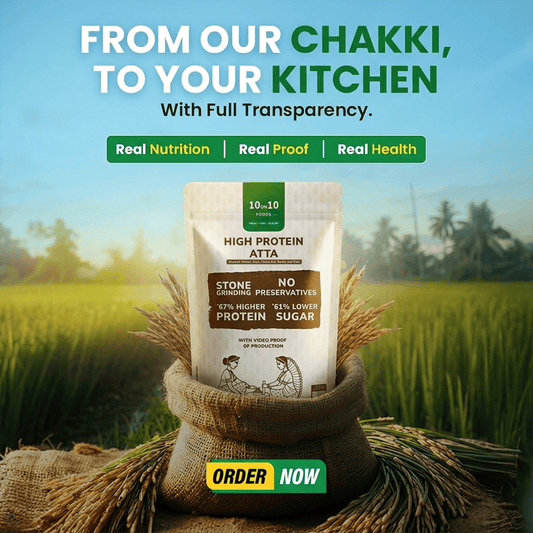
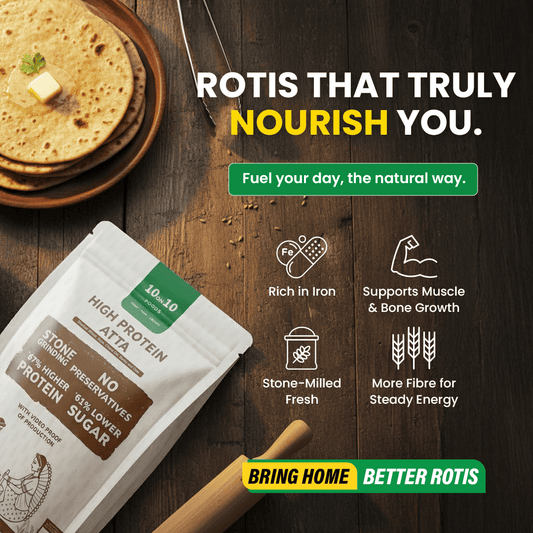
If your family member eats 3 rotis per person per day, then swap your regular wheat atta with 10on10 Food’s high protein atta and see the magic. With this transition, each roti gives an extra 3 - 4g of protein. This means there will be 10 - 12g extra per person daily, 300g+ extra protein per person per month, and no need to cook a single additional dish.
The Maths That Changes Everything
Below, we’ve broken down what swapping your atta actually does to your daily protein intake, based on a standard 35g dough per roti:
|
Metric |
Regular Atta |
10on10 Food’s High Protein Atta |
|
Protein per 100g flour |
10g – 12g |
20g – 25g |
|
Protein per roti (35g dough) |
3g – 4g |
7g – 8.75g |
|
From 3 rotis per day |
9g – 12g total |
21g – 26.25g total |
|
Extra protein daily |
— |
+12g – 17g / day |
|
Extra protein per week |
— |
+84g – 119g |
|
Extra protein per month |
— |
+360g – 510g |
|
Extra protein per year |
— |
4.3 kg – 6 kg worth of additional protein |
With 10on10 Food’s high-protein atta/flour, you don’t need to add any supplements, change your recipes, or follow a complicated diet plan. It is enough to boost your daily protein intake by up to 12–17 grams, single-handedly.
The Bottom Line
When Indian diets derive about 62% of calories from carbohydrates, it’s easy to see why many people feel tired, struggle with muscle loss, or hit slowdowns despite eating “enough”. Therefore, the issue isn’t that you don’t eat; it’s that you rely heavily on cereal-based proteins, which have lower absorption.
Try to pay more attention to your plate and consider including sources like dals, dairy, nuts, seeds, and whole grains. This way, you can swap your diet from carb-heavy to protein-positive.
To make a small start, explore our Everyday Protein range — including High Protein Atta and besan — and add up to 12–17g of extra protein daily. No additional supplements, no complicated meal plans, no changed recipes.
Sometimes, the biggest health shift doesn’t come from adding more; it comes from choosing better.
FAQs
1. Why do most Indian diets lack sufficient protein?
Most Indian diets are heavily based on carbohydrates like rice, roti, and grains, which provide limited protein. While these foods are filling, they often do not meet daily protein requirements, leading to a nutritional gap.
2. How can I increase my daily protein intake without changing my diet?
The easiest way is to upgrade your everyday staples. For example, switching from regular wheat flour to a high-protein atta or adding protein-rich foods like dals, paneer, and nuts can significantly improve your intake without major diet changes.
3. What is the simplest way to start a high-protein diet in India?
Start by including a protein source in every meal, choosing smarter alternatives like high-protein flours, and adding healthy snacks such as seeds or nuts. Small daily changes can make a big difference over time.